
Walk through any trailhead parking lot and you will see roof racks stacked with gear that looks incredible and does nothing. Shiny hardware bolted on for the photo, half of it never used, some of it downright dangerous if the day ever goes sideways. The truth nobody selling gear wants to say out loud is that a lot of the recovery kit people carry is dead weight. When you are actually buried to the frame, only a handful of items earn their keep.
This is a buyer’s guide for the kit that works. Not the biggest kit, not the prettiest kit, the one that gets you home. We will go item by item, tell you what specs matter, and flag the gear that is more marketing than muscle. If you want the technique side of getting unstuck, we cover that in depth in our self-recovery playbook. This piece is about what to buy.
Start With The One Rule That Keeps You Alive
Before we talk gear, understand this: recovery kills people every year, and almost never because the truck was too stuck. It is because something under massive tension let go and became a projectile. A snapped strap or a shackle ripping loose carries enough energy to punch through a windshield or a person.
 Getting stuck is easy. Getting out safely is the skill that gear buys you.
So every buying decision below is filtered through one question: what happens if this fails under load? Good gear is rated well above your loads, is inspected before every use, and fails in a way that does not kill you. Cheap gear off a no-name marketplace listing with a made-up rating is not a bargain. It is a liability strapped to 5,000 pounds of moving metal. Buy from brands that publish real minimum breaking strength numbers and back them up.
Traction Boards: The First Thing You Should Own
If you buy one recovery item, buy a pair of traction boards. They solve the single most common trail problem, a tire that has dug itself into sand, mud, or snow, and they do it with zero stored energy. Nothing to snap, nothing to whip back at you. You clear the packed material in front of the tire, wedge the board tight against the tread, and gently drive up and out.
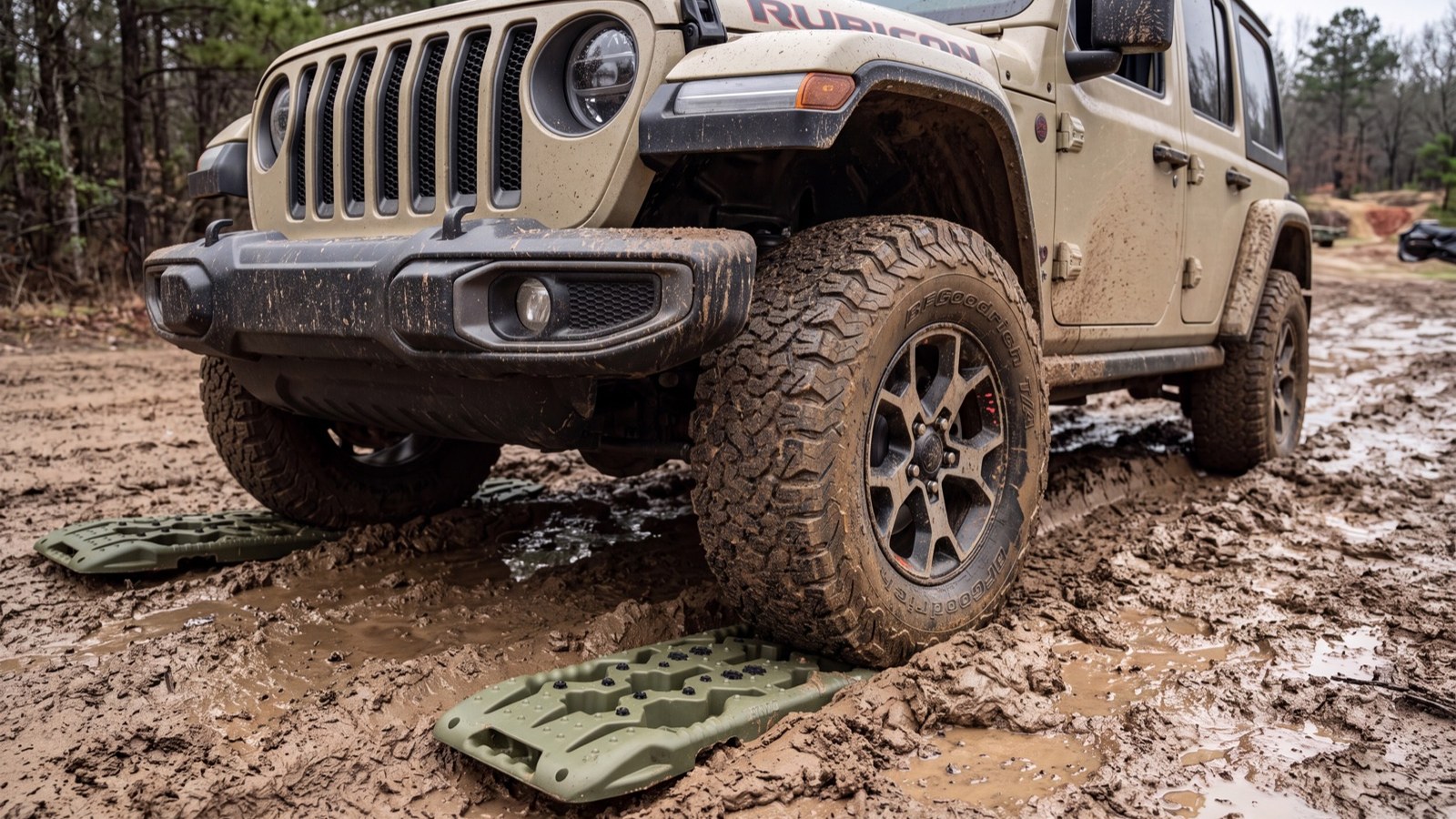 Traction boards bridge the gap between a spinning tire and real grip.
What matters when buying: the material and the lugs. Quality boards use reinforced nylon that flexes without shattering in the cold. Look for aggressive, replaceable or metal-reinforced lugs. The cheapest boards spin the tire and melt the nubs into slick nothing on the first hard try. A good set survives years of abuse. We put a full set through the wringer in our traction board review. Skip the ultra-budget knockoffs. This is the one place where the mid-tier and premium boards genuinely outperform.
The Shovel Nobody Wants To Carry
A folding shovel is boring, cheap, and one of the most useful things in the truck. Half of getting unstuck is just moving material: digging out a high-centered chassis, clearing behind the tires, ramping a hole so the boards can bite. You cannot buy your way around it.
 Soft sand and deep ruts are where a shovel earns its keep, clearing material so the tires or boards can bite.
Get a full-size or a solid folding shovel with a metal blade, not a flimsy plastic camp trowel. It needs to actually cut into packed clay and pry against rock. A T-handle or D-handle gives you leverage. This is one item where you do not need to spend much, but you do need it to be real. A collapsible steel shovel that locks solid at the joint is all you need.
Kinetic Rope vs Tow Strap: Know The Difference Or Get Hurt
This is where people get it wrong most often. A kinetic recovery rope and a tow strap look similar and are used for completely opposite jobs.
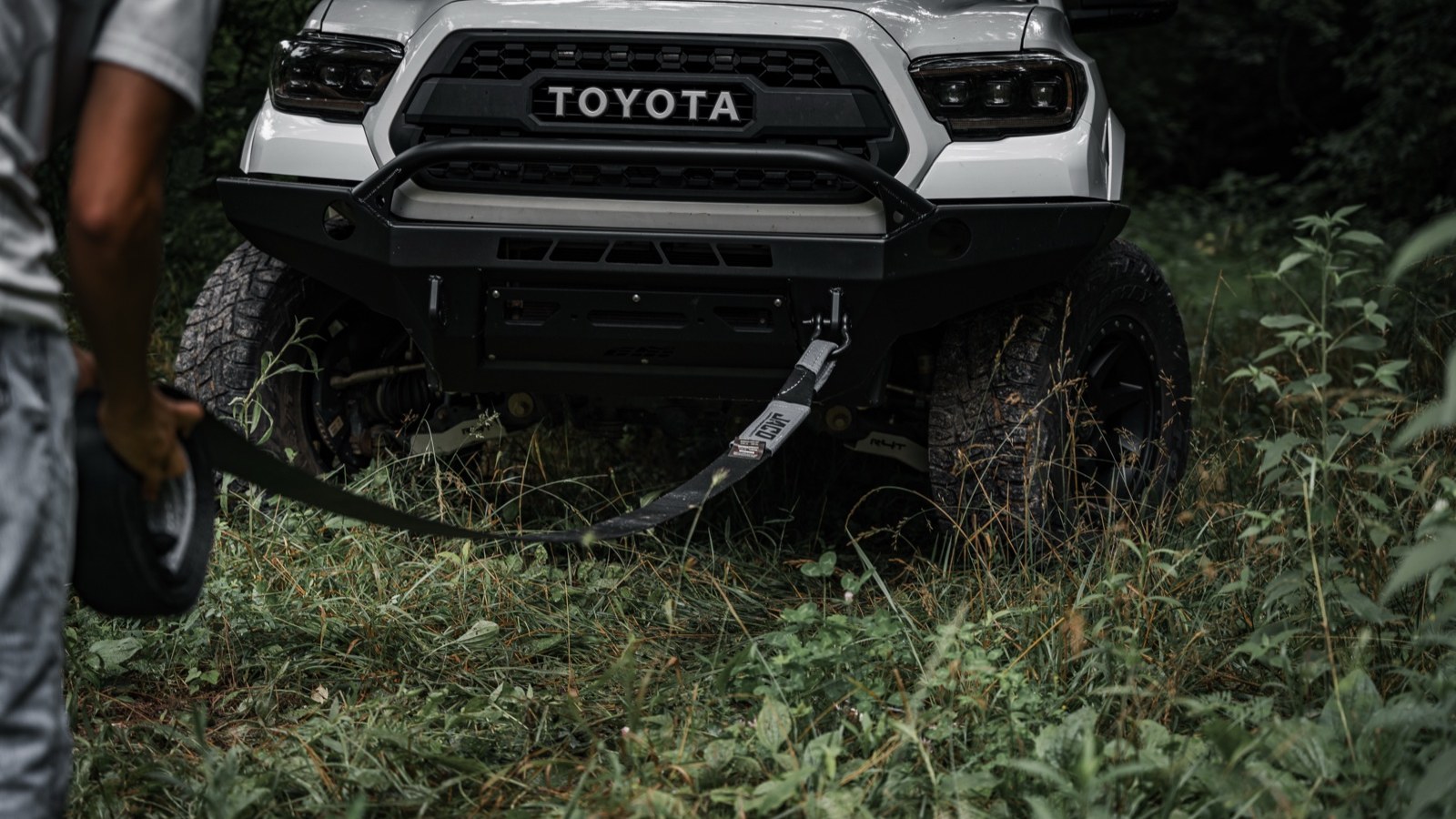 Rig only to rated recovery points, and match the rope to the job: kinetic for a hard pull, tow strap for a slow tow.
A kinetic rope is built to stretch, usually around 20 to 30 percent. That stretch stores energy as a recovery vehicle takes a running start, then releases it to pull a badly stuck rig free with a smooth, elastic yank instead of a violent jerk. A tow strap is the opposite: minimal stretch, meant for slow, straight-line towing of a vehicle that can still roll. Using a tow strap for a hard kinetic pull is dangerous, because with no stretch to absorb the shock, all that force slams into the anchor points and the strap. That is how hardware gets ripped off bumpers.
Buy the rope rated for your rig. The widely accepted guideline is a breaking strength of roughly two to three times the loaded weight (GVWR) of the heaviest vehicle in the recovery. Too strong is fine. Too weak is a broken rope under load. For most half-ton trucks and SUVs, a 7/8-inch rope in the 28,000 to 30,000 pound breaking-strength range is a sensible middle ground. If you carry only one, make it a quality kinetic rope over a plain tow strap.
Soft Shackles Over Steel D-Rings
The old steel D-ring (bow shackle) works, but the off-road world has largely moved to synthetic soft shackles for good reason. A soft shackle is a loop of high-strength UHMWPE rope, and a quality 3/8-inch one routinely carries a minimum breaking strength in the 30,000 to 45,000 pound range, on par with or exceeding a comparable steel D-ring that weighs several times more.
The safety case is the real selling point. If a steel shackle rips loose, it becomes a chunk of flying metal. If a soft shackle fails, it does not carry the same lethal projectile energy, and it will not gouge your recovery points or expensive rope. They are lighter, they fit through tight recovery points a bulky steel bow will not, and they are simpler to rig. Carry a couple. If you keep steel shackles too, buy forged ones with a stamped working load limit, never the unrated hardware-store lookalikes.
Winch, Snatch Block, and Line Dampener
A winch is the heavyweight of self-recovery and the biggest single investment. If you wheel alone or run genuinely hard trails, it changes what you can get out of. Size it to at least 1.5 times your loaded vehicle weight as a minimum; more is better. Synthetic winch line is now the standard over steel cable: lighter, safer if it fails, and easier to handle, though it needs care around heat and abrasion.
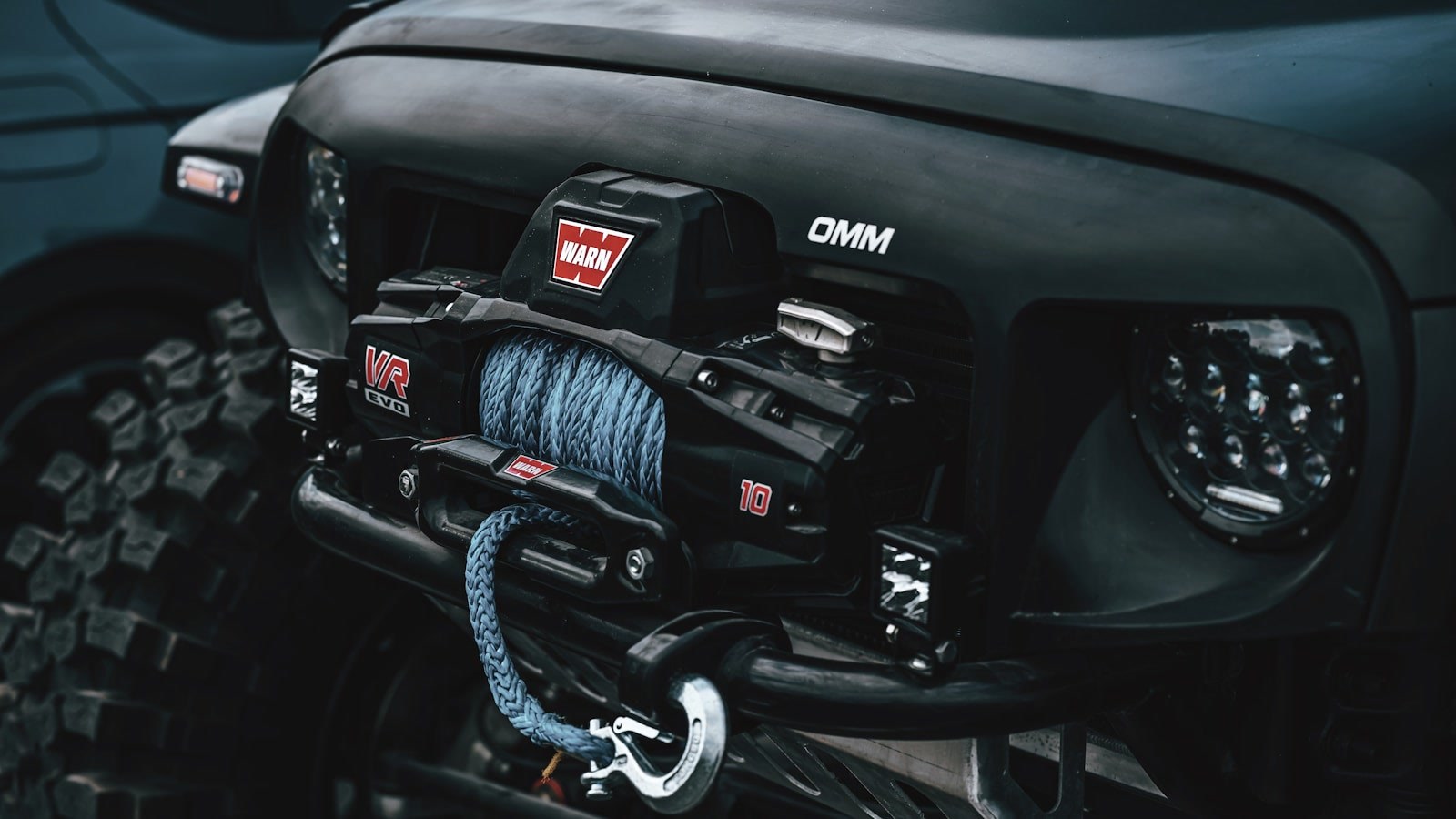 A winch turns a solo bad day into a self-rescue, but only with the right supporting gear. Photo: Timothy Rubby / Unsplash
A winch alone is not a kit. Two accessories make it work. A snatch block (or a modern winch ring) lets you run a double-line pull, which roughly doubles your pulling power and takes strain off the winch, and it lets you redirect the line around an off-angle anchor so you can still pull in a straight line to the drum. The second is a line dampener, a heavy blanket or bag you drape over the middle of the line under tension. If the line or a fitting ever fails, the dampener drags the whiplashing line down toward the ground instead of letting it snap back at head height. It is a cheap piece of gear that turns a potentially lethal failure into a scare. Never winch without one.
Round it out with a tree saver strap (a wide, low-stretch strap that protects both the tree and your line when you use a trunk as an anchor) and a decent pair of gloves so a frayed line does not shred your hands.
The Gear To Skip Or Think Twice About
Here is where the “half your kit is useless” line comes from. The classic example is the hi-lift jack. It looks the part strapped to a roof rack, but for most modern rigs it is heavy, awkward, and genuinely dangerous in untrained hands, and it only works if you have solid steel bumpers or rock sliders to lift from. Plenty of experienced wheelers have quietly retired theirs in favor of traction boards, a proper bottle jack sized to their vehicle, and a shovel. If you do not have hard mounting points and have not practiced with it, that money is better spent elsewhere.
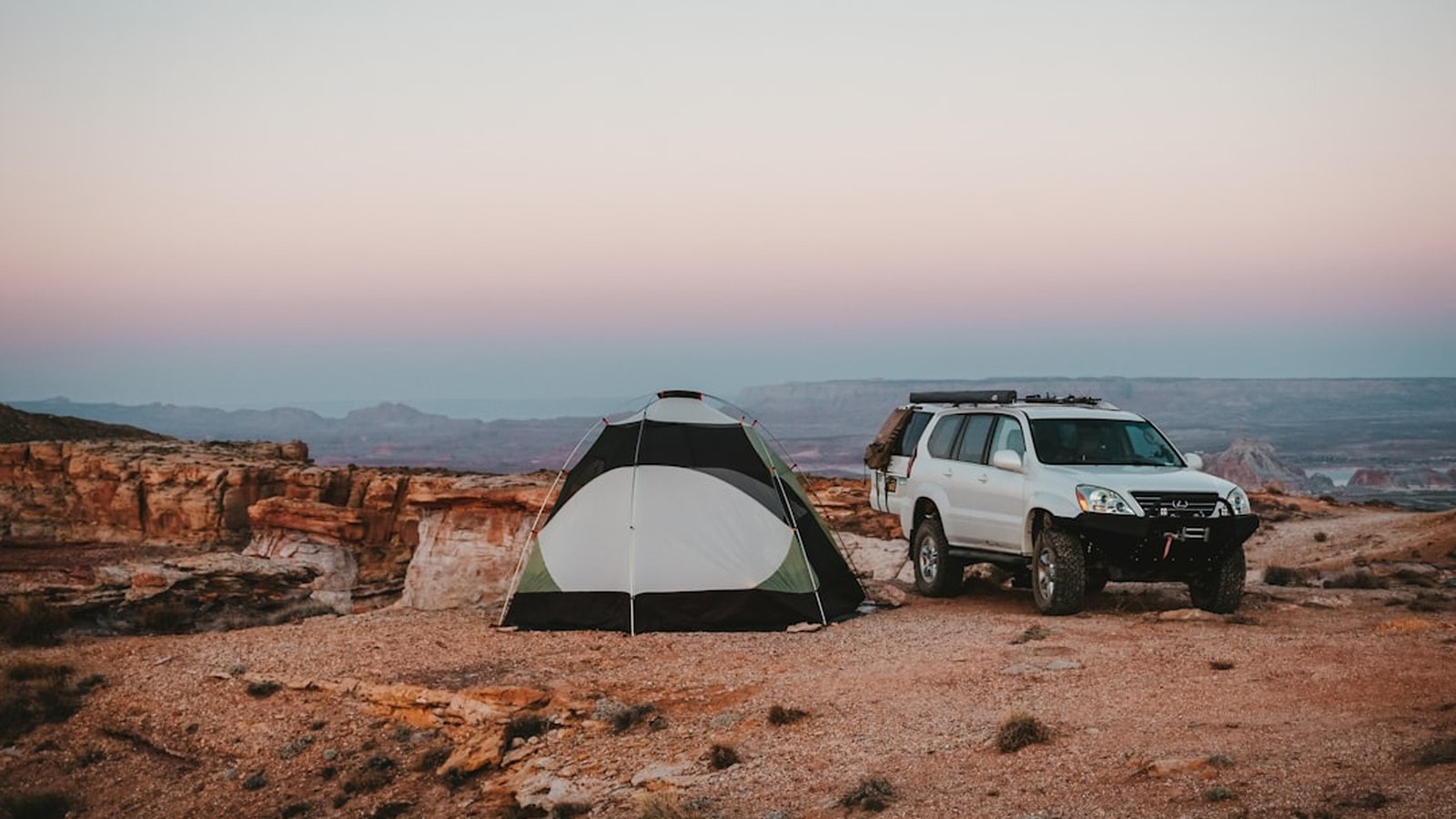 A smart, compact recovery kit beats a roof rack full of gear you have never used. Photo: Christian Schrader / Unsplash
The other trap is the giant bargain “recovery kit in a bag” from an unknown seller. These bundle a tow strap, some stamped-metal shackles, and gloves with impressive-sounding ratings and no real testing behind them. The strap might be fine for pulling a stump. Trusting it in a kinetic recovery is how people get hurt. Buy the pieces individually from brands that publish real breaking strengths, and you will end up with a lighter, cheaper, and far more trustworthy kit than the all-in-one bag.
And never, ever rig a recovery to a trailer ball. It is one of the deadliest mistakes in off-roading. A tow ball is engineered for a downward towing load, not the shock load of a recovery, and when one snaps off it flies like a cannonball. Rig only to rated, engineered recovery points designed for the job.
The Kit That Actually Earns Its Space
Strip away the noise and the list is short. A pair of quality traction boards. A real shovel. A kinetic rope rated for your rig. A couple of soft shackles. A tree saver and gloves. Add a winch, a snatch block, and a line dampener if you wheel hard or wheel alone. That is a kit that fits in a duffel, weighs a fraction of the roof-rack pile, and will genuinely get you home.
The gear is only half of it. The other half is knowing how to use it, calmly, before you are buried and the light is fading. Buy good, buy rated, practice in your driveway, and read our self-recovery playbook so the day you need this stuff, you already know exactly what to reach for.
Hero photo: Thomas Tucker / Unsplash