
Ask anyone who has run both, and they will tell you the same thing: if the Rubicon is California’s most famous hard trail, the Dusy-Ershim is its most serious. This is the one people talk about in a lower voice. It is longer, higher, more remote, and by most honest accounts a good deal harder than the Rubicon, a 33-mile granite gauntlet strung between two wilderness areas where the terrain never really lets up and there is no easy way out once you commit. People who have recently run the Rubicon and then run the Dusy come back saying the Dusy was three to six times harder. That is not marketing. That is the reputation this trail has earned.
So before you point a tire up it, read this whole thing. The Dusy-Ershim is a multi-day backcountry expedition that happens to involve rock crawling, not a day trip with obstacles. It rewards the prepared and punishes the underbuilt without mercy, and the country it runs through is some of the most beautiful high Sierra you will ever see from behind a wheel. Here is the honest, useful version of everything that matters.
What the Dusy-Ershim actually is
The Dusy-Ershim OHV Route, officially trail 7S32, runs roughly 33 miles across the high country of the Sierra National Forest in Fresno County, up in the Sierra Nevada northeast of Fresno. Its two ends are Courtright Reservoir on the south and the Kaiser Pass area near Lake Edison on the north, and everything in between is a narrow 600-foot corridor threaded between the John Muir Wilderness and the Dinkey Lakes Wilderness. That corridor is the whole reason the trail exists. It is a legal thread of motorized access surrounded on both sides by federally protected wilderness where no vehicle may go, which is exactly why staying on the route here is not a suggestion, it is the trail’s reason for surviving.
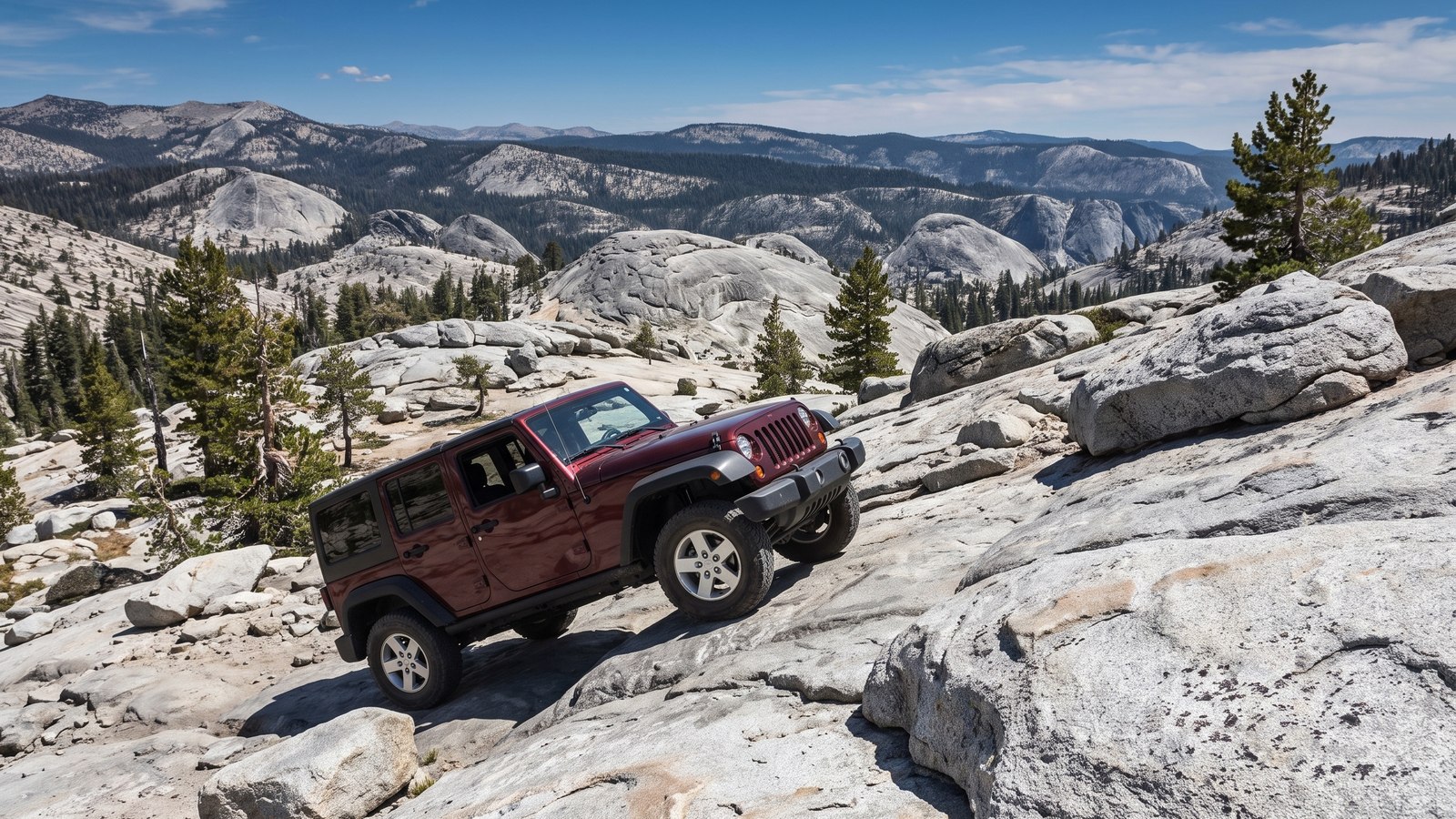
The route starts at about 8,400 feet at Courtright and climbs to over 10,000 feet at Thompson Lake, then stays up in that 9,000-to-10,000-foot range for most of its length. This is genuine alpine and subalpine terrain: gray granite slabs and boulder fields, tight stands of lodgepole and fir, wet meadows, and a string of jewel-like lakes that make the punishment worth it. It combines long, slow, technical rock crawling with real overland travel, and it is widely considered one of the hardest multi-day off-road trips you can do in the country right now.
Do not let the mileage fool you. Thirty-three miles sounds like an afternoon. It is not. Most groups take three to four days to run the Dusy-Ershim, and some take five. A seasoned, well-built group might push it in two if they had to, but nobody who has been up there recommends rushing it. This is a trail measured in careful tire placements and winch pulls, not miles per hour.
How to get there and where it starts
The standard way onto the trail is from the south, at Courtright Reservoir. From Highway 168 near Shaver Lake, take Dinkey Creek Road, then McKinley Grove Road, then turn onto Courtright Road and follow it to Courtright Reservoir. It is a long drive up, roughly two hours from Fresno, and the pavement gives way to good dirt as you climb. At the reservoir you cross the dam on the east side of the lake and follow the road until you reach the Dusy-Ershim OHV Route sign. That is where you air down, form up your group, and start.
Courtright is more than a trailhead. It is the last place with anything resembling services, a staging area, and the popular Voyager Rock Campground nearby with fire grates and tables, a good spot to camp the night before and fish the reservoir. Once you leave the dam, you are committed. There are no easy bailout points on the Dusy-Ershim. There is no spot partway through where you can quietly peel off and drive an easy road back to the truck. Once you are in, you finish the trail, and that single fact should shape every decision you make about your rig and your group before you ever leave the dam.
Most people run it south to north, from Courtright toward Kaiser Pass, and that is the direction most trail notes describe. Whichever way you go, understand that this is deep, remote country with no cell service and no quick way out.
The obstacles: granite, mud, and Thompson Hill
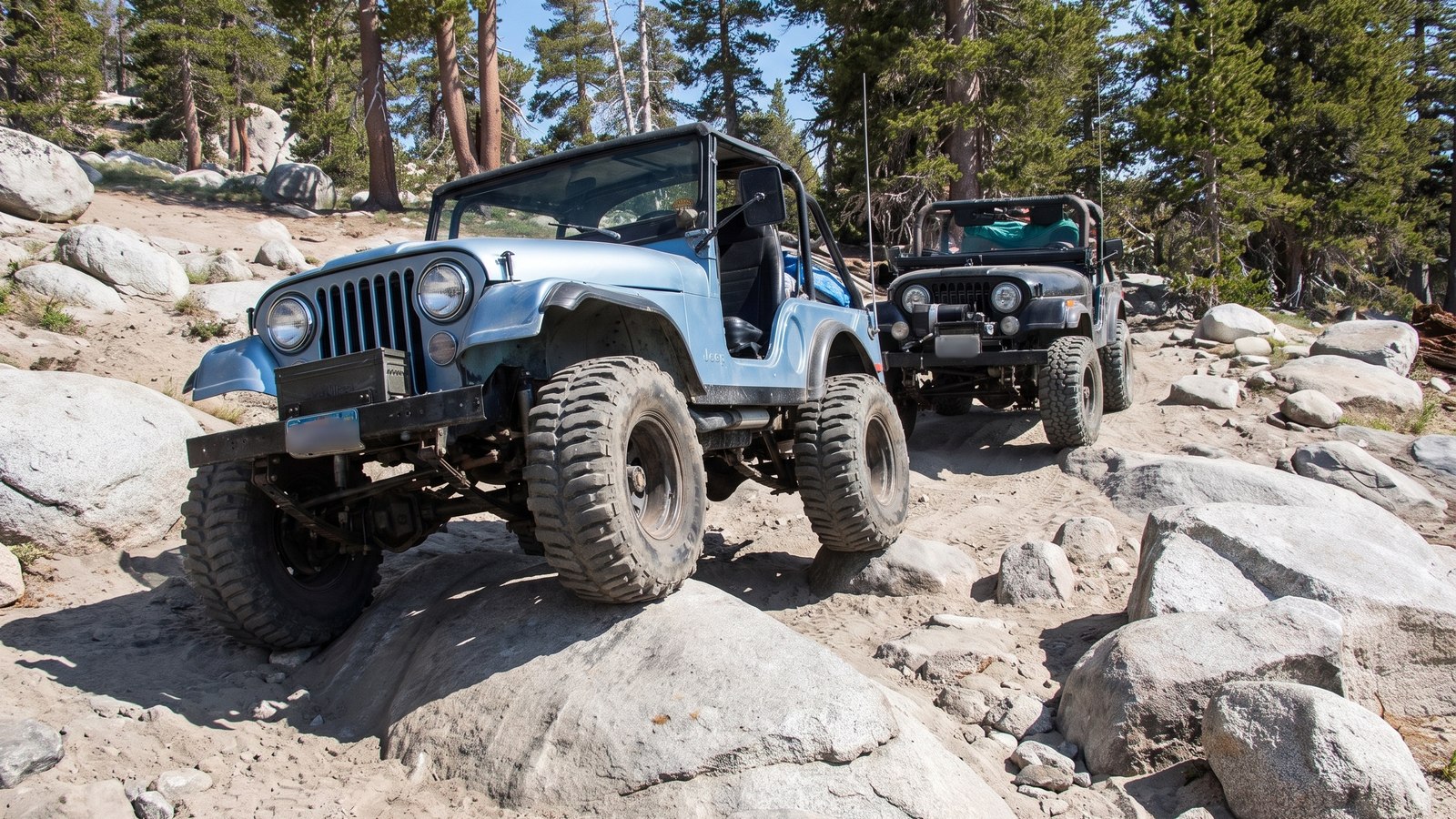
The Dusy-Ershim throws just about every kind of hard terrain at you, and it does it over and over for miles. Much of the trail is slow, deliberate rock crawling over large granite boulders, the kind of terrain where you place one tire at a time and a good spotter earns every bit of trust you give them. Long stretches cross open granite slabs marked with rocks, because there is no dirt tread to follow, just bare granite and someone’s cairns pointing the way. There are mud bogs, a notoriously slippery log road that turns treacherous with wet tires, tight squeezes between trees and boulders, water crossings that run seasonally, and steep, rutted descents.
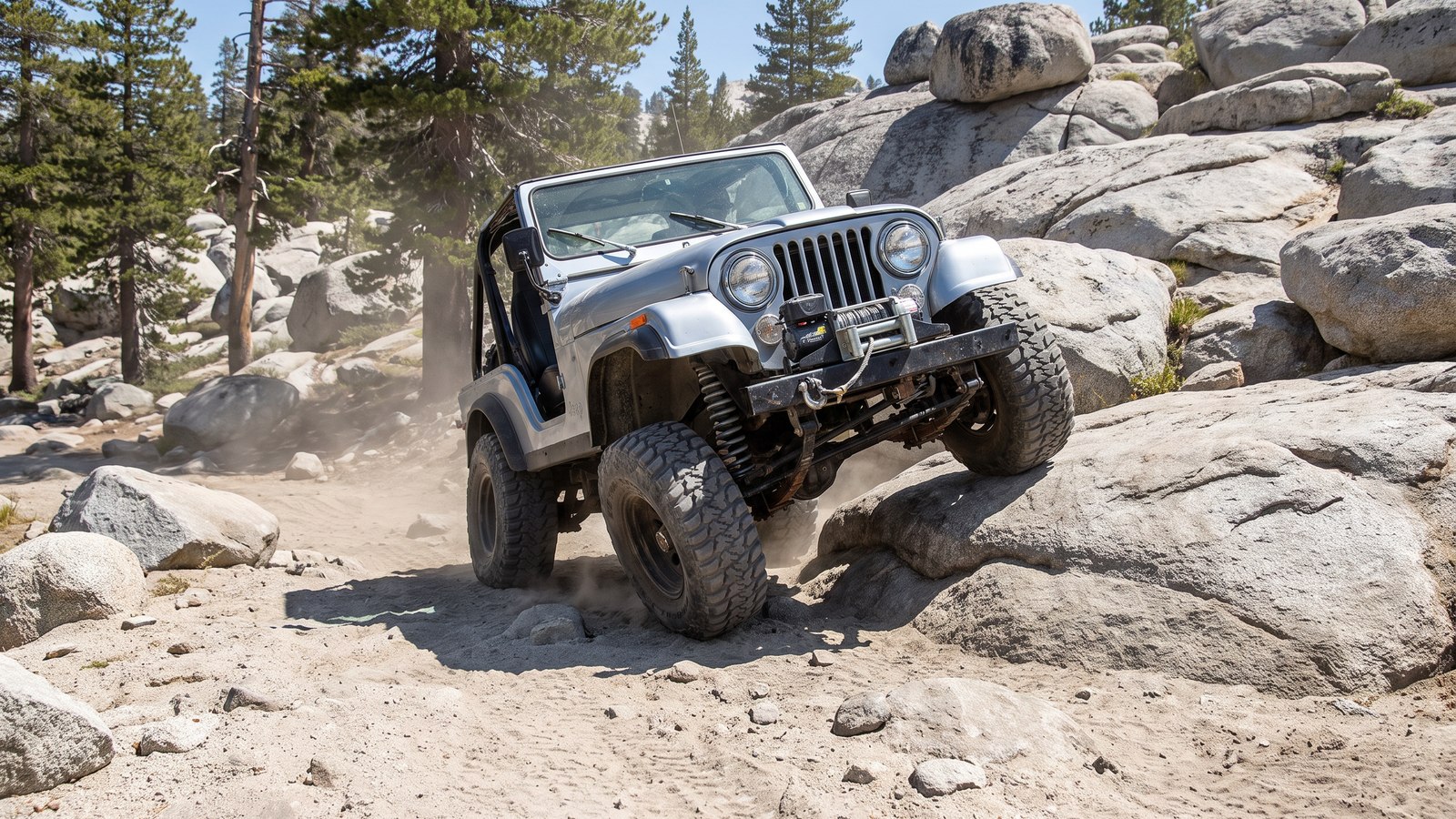
The trail’s signature obstacle is Thompson Hill. It is a steep climb packed with large, loose boulders, and it is where a lot of rigs leave parts on the ground. Breakage on Thompson Hill is common enough that experienced groups plan for it. There is a well-known steep rock section around the 1.9-mile mark that locals call Chicken Rock, an early taste of what the trail is going to ask of you. And there is a stone-and-log bridge crossing Dinkey Creek that has become one of the trail’s iconic images.
The crucial thing to understand about the obstacles here is that there are essentially no bypasses for the major ones, and turning around is rarely an option once you are committed to a section. You do not get to look at Thompson Hill, decide it is too much, and take the easy way around. There is no easy way around. You either drive it, winch it, or you are the reason a whole group is stuck on the side of a mountain. That is why honest self-assessment before you start matters more here than on almost any other trail.
The lakes, the camps, and why people fall in love with this trail
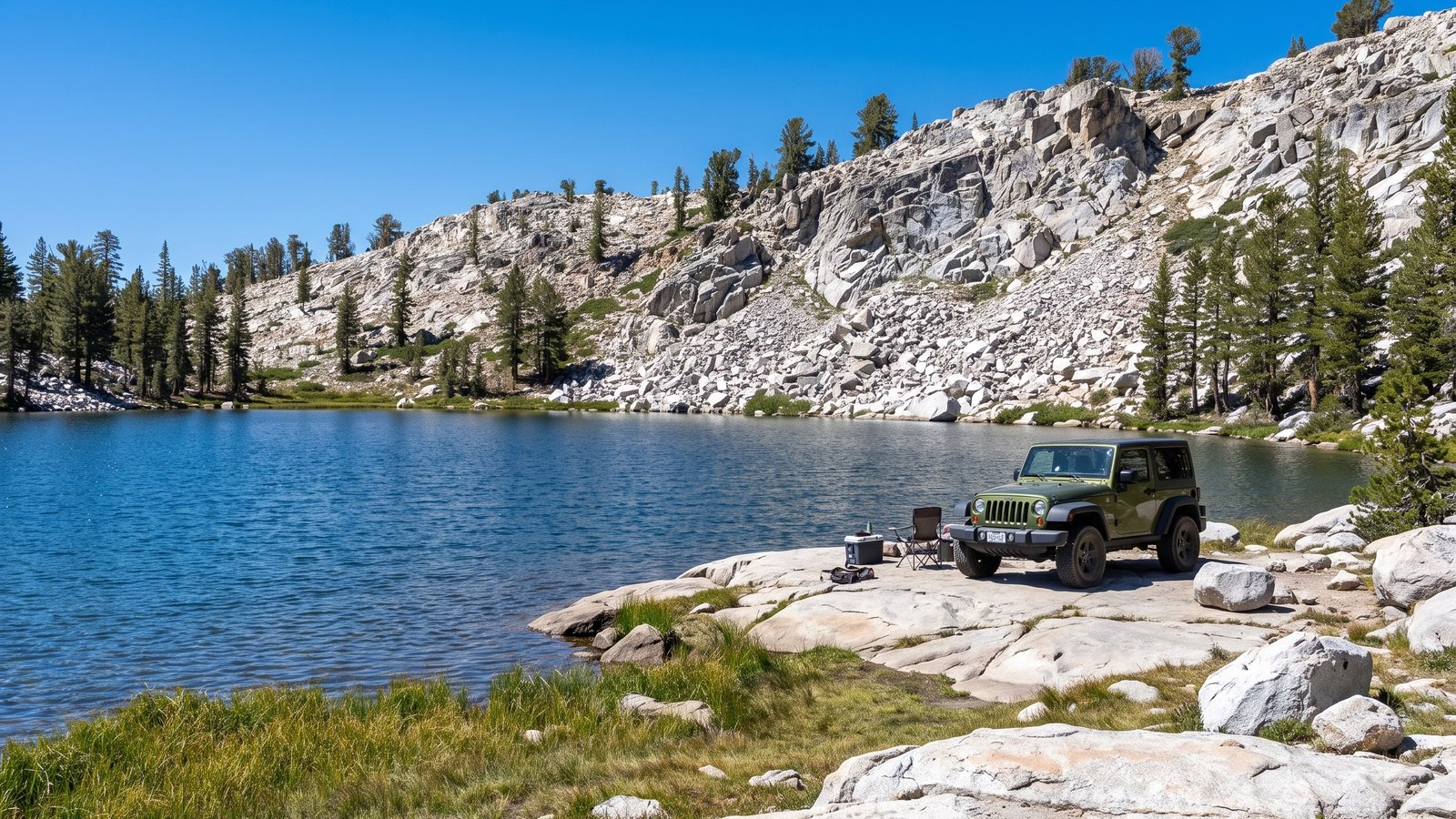
For all its brutality, the Dusy-Ershim is not a grim trail. It runs through some of the most beautiful backcountry in the Sierra, and the payoff for the hard miles is a string of alpine lakes you get to camp beside with almost nobody else around. Thompson Lake, Ershim Lake, East Lake, Mirror Lake, and Lakecamp are the classic overnight spots, each with a granite backdrop, crisp alpine air, and the kind of solitude you cannot find on a crowded trail.
The fishing is a genuine draw. Lakecamp holds rainbow trout, which makes it unusual, because the other lakes along the route hold brook trout. Mallard Lake, an easy twenty-minute walk beyond Lakecamp, is another spot worth the stroll with a rod. Groups that run the Dusy right build in time for this. They do not treat it as a checklist to conquer as fast as possible. They wheel hard by day, make camp at a lake by evening, fish, and let the place work on them. That balance of serious technical challenge and real backcountry beauty is exactly what makes this trail a bucket-list run for people who take wheeling seriously.
The tight forest sections and log crossings
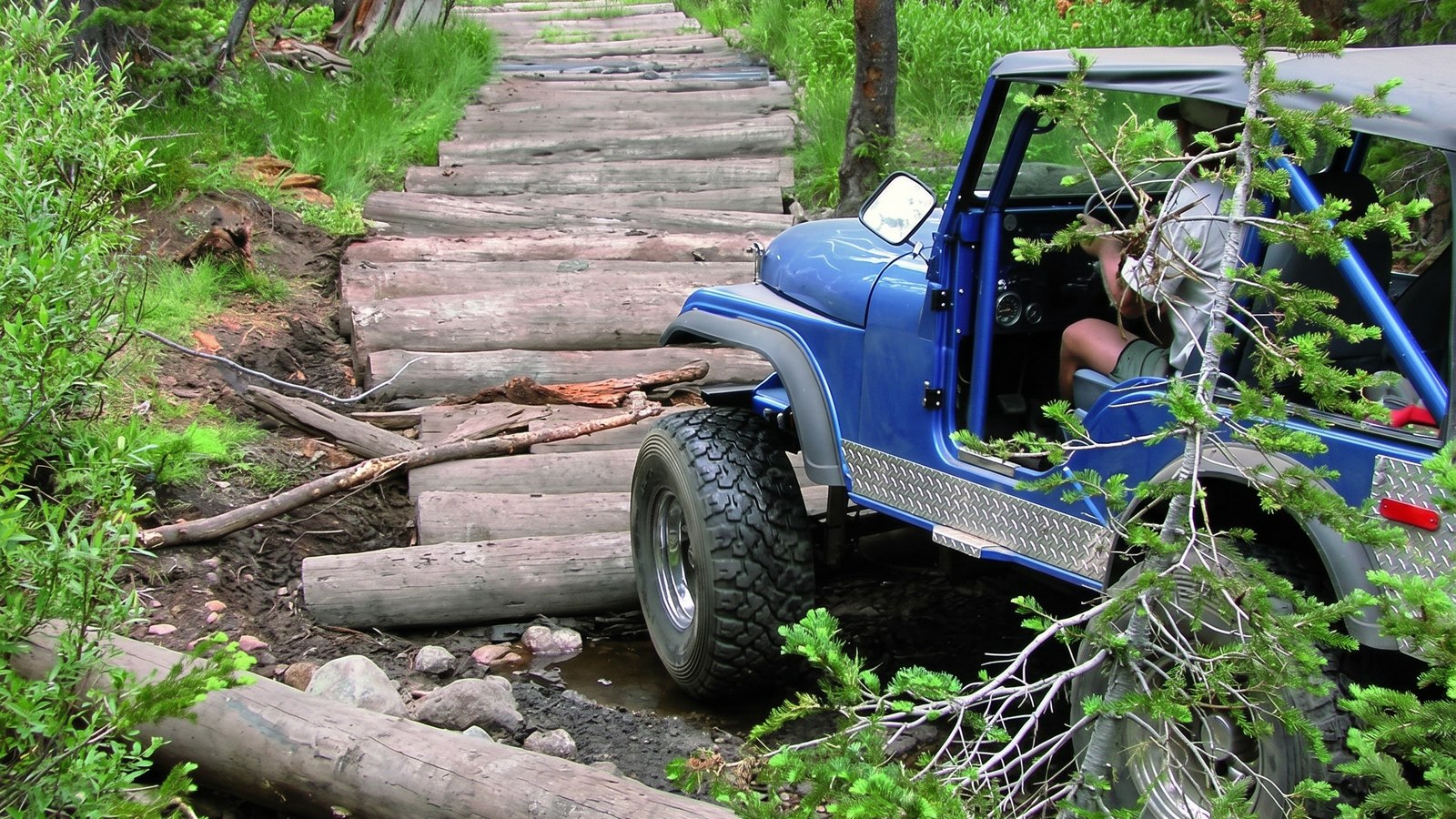
Between the granite and the lakes, the Dusy-Ershim winds through long stretches of tight lodgepole and fir forest on rough, rutted two-track. These sections feel almost mellow compared to the boulder gardens, but they carry their own hazards. The trail squeezes narrow between trees, and this is where wider modern rigs pay the price for their girth. The trail was originally cut for short, narrow vehicles like CJs, and while a modern JK or JL absolutely does the Dusy with good spotting and patience, the tree squeezes are real and they will test your pinstripe tolerance.
The famous log road is in this category too, a stretch of corduroy logs laid over soft or wet ground that turns slick and unnerving when tires are wet. Take it slow, keep momentum modest and predictable, and let a spotter keep your wheels on the logs. These connective forest miles are where you cover ground between the big obstacles, and they are a good place to remember that this trail is a marathon, not a sprint.
The rig you actually need
Let me be blunt, because the Dusy-Ershim punishes the underbuilt harder than almost any trail in California. This is not a trail you casually upgrade your way onto. It is a trail you bring a genuinely capable, well-sorted rig to.
The honest minimum is lockers front and rear, a lift with real suspension travel, 33-inch tires at the absolute floor with 35s to 37s strongly preferred, and serious armor underneath. That means skid plates, rock sliders, and bumpers you do not mind using, because you will use them. A winch is technically optional but so strongly recommended that you should treat it as required, and a second rig with a winch is better. High-clearance and low-range gearing are non-negotiable. Good articulation and recovery points round out the picture.
Then, because this trail breaks things, you carry spare parts and the skill to use them. Real spares: U-joints, axle shafts, a spare driveshaft if you can, a tire repair kit, an air compressor, a full tool kit. Body damage is close to guaranteed on the Dusy-Ershim even for excellent drivers, and mechanical failure is common enough that even very built rigs sometimes limp off this trail. The reality, stated plainly by people who run it, is that even the most built rigs can leave this trail with a mechanical failure. You need to be completely self-sufficient, because the nearest help is days away by trail and there is no cell signal to call for it.
And the cardinal rule: never run the Dusy-Ershim alone. Travel with at least one other vehicle, and ideally a small group of well-equipped rigs. Full-size pickups and long-wheelbase vehicles are specifically not recommended here, both for the tight squeezes and the difficulty of recovering something that big in this terrain. Your group is your winch anchor, your spare parts, your recovery, and your only realistic way out of trouble.
Permits, fees, and the rules that keep this trail open
The paperwork is manageable but do not skip it. Because the route travels through the high Sierra and touches designated wilderness on both sides, there are real rules. A California Campfire Permit is required if you plan to have a campfire or use a camp stove, and it is free. Because of the extreme fire danger in these forests, campfire restrictions are common and are often in force, so be prepared to cook on a stove and to go without a fire entirely if conditions demand it. Always check the current fire restrictions with the Sierra National Forest before you go.
The single most important rule on the Dusy-Ershim is to stay on the trail. The route is a narrow 600-foot corridor with federally protected wilderness pressing in on both sides. Straying off the route is not just bad form, it is illegal and it is exactly the kind of thing that gets a trail like this closed. Pack out everything you pack in, use Tread Lightly and Leave No Trace practices, and treat the corridor as the fragile privilege it is. This trail stays open only because the people who run it prove, year after year, that they can be trusted with it.
Also plan for zero connectivity. Cell service on the Dusy-Ershim is effectively nonexistent. Carry a satellite communicator or a ham or GMRS radio for emergencies, download your offline maps ahead of time, and leave a detailed trip itinerary with someone at home.
Best season and the snow window
The Dusy-Ershim is a short-season trail, gated by snow at both ends of summer. The Forest Service manages the gates and closes the route during snow season, and it typically opens for a window running from about August 1 to November 1, though the exact dates shift every year with the snowpack. In a heavy snow year the opening can slip later into summer, and in any year the first serious Sierra storm can shut the high country down fast in the fall.
That leaves a genuinely narrow window, roughly August through October, when the trail is open, the high passes are clear, and the weather is reasonably stable. Even inside that window, mountain weather moves in fast and storms can catch you at 10,000 feet with no easy way down. Always check current conditions and the gate status with the Sierra National Forest or a local four-wheel-drive club before you plan a trip, and watch the forecast right up until you leave. When the high country is socked in, the Dusy-Ershim is not a challenge to push through. It is a closed door, and the right answer is to wait for next season.
Is it worth it?
If you are an experienced off-roader with a genuinely built rig and a taste for real backcountry, the Dusy-Ershim is absolutely worth every boulder, every winch pull, and every scrape down the side of your rig. It is an unforgettable combination of relentless technical terrain, staggering Sierra Nevada beauty, and pure isolation that you simply cannot find on the more crowded famous trails. You will come off it exhausted, probably dinged up, and grinning ear to ear.
But it demands respect on a level few trails do. Build the right rig, run with a strong group, carry real spares, stay on the corridor, respect the weather and the fire rules, and give yourself the days it deserves. Do that, and you will have run one of the hardest and most rewarding trails in the American West. Cut corners on any of it, and this trail will remind you, in the middle of nowhere, exactly why it has the reputation it does.