
If there is one trail every serious wheeler keeps on the bucket list, it is this one. The Rubicon runs 22 miles through the Sierra Nevada, due west of Lake Tahoe and about 80 miles east of Sacramento, and it has earned its reputation the hard way. This is the trail that 4x4 manufacturers have used as a proving ground for decades. It is the reason Jeep slapped the name “Rubicon” on its top Wrangler trim back in the 2003 model year. People fly in from other countries to drive it. It is, fairly, the most famous off-road trail in America.
It is also not a trail you bag on a whim. The mileage is short and the days are long, the granite eats body panels for breakfast, and the rules around it exist because people fought hard to keep it open. So here is the honest, useful version of everything you want to know before you point your front tires at the Granite Bowl.
What the Rubicon actually is
The route is part maintained road and part raw 4x4 trail. The western maintained section is Wentworth Springs Road, which climbs out of Georgetown up in California’s Gold Country. The eastern maintained section is the McKinney Rubicon Springs Road, which drops you down to Lake Tahoe near Tahoma. In between sits the real prize: roughly 12 miles of unmaintained trail through the Eldorado National Forest, the Tahoe National Forest, and the Lake Tahoe Basin Management Unit. That granite middle is the Rubicon people mean when they say “the Rubicon.”
The whole thing lives between about 6,000 and 7,200 feet, so even in summer the nights get cold and the weather can turn on you. Do not let the 22-mile number lull you. Most groups take two to three days, and that is not because they are slow. It is because progress out here is measured in feet, not miles.
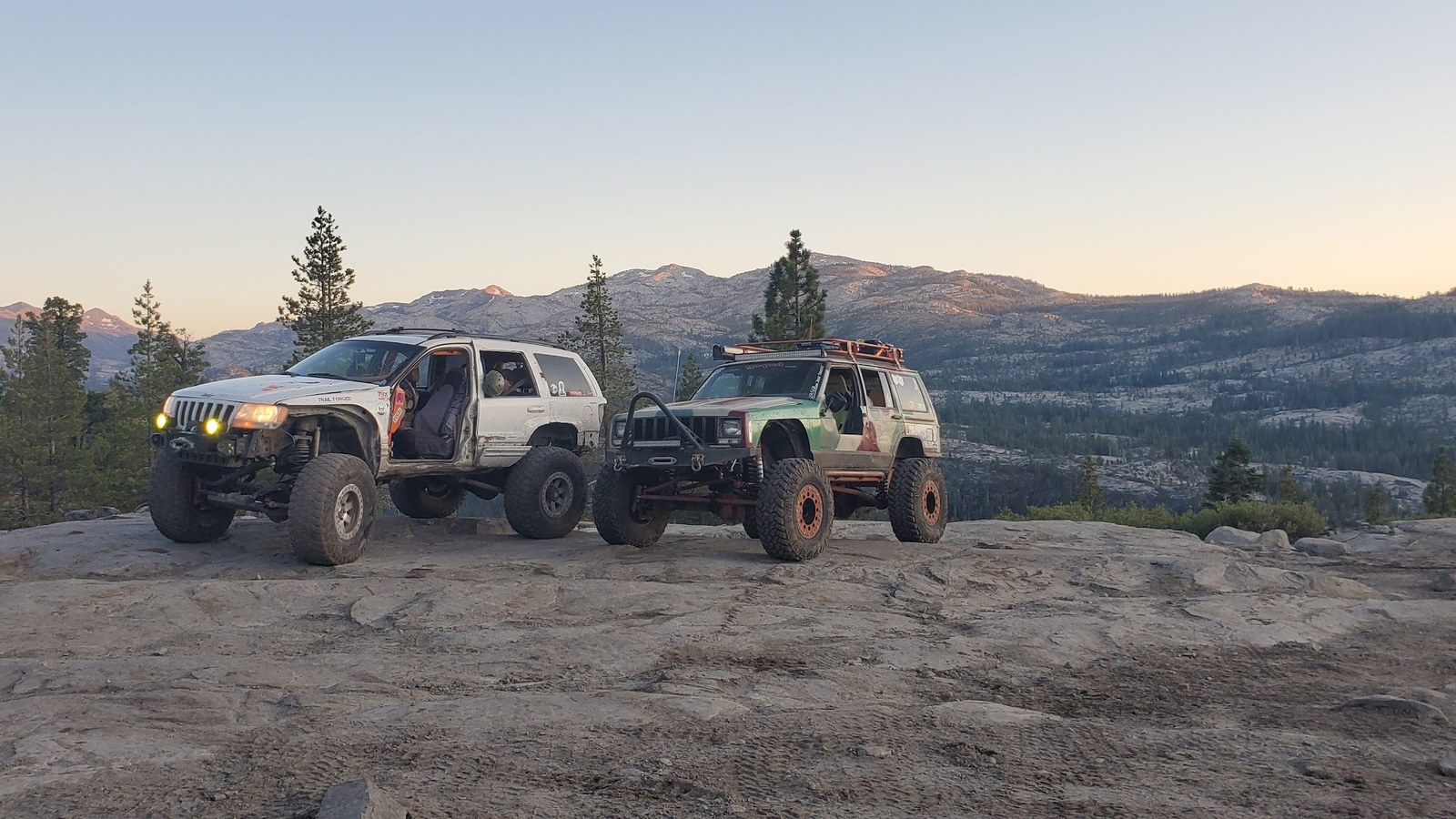 Photo: Damageinc10 / Wikimedia Commons (CC BY 4.0)
The three ways in
There are three entrances, and which one you pick shapes your whole trip.
The Loon Lake entrance, at the spillway, is the most popular start. It drops you straight into the Granite Bowl, a wide open valley of bare rock that is one of the signature sights of the trail. Just past it is the Gatekeeper, an obstacle El Dorado County and the Eldorado National Forest tried to soften with explosives back in 2004 to cut down on wheel spin and sediment runoff. It did not really work. The Gatekeeper is still a genuine challenge by any normal standard.
The Wentworth Springs entrance, at Gerle Creek, is the original historic way in, and it does not ease you into anything. It opens with Devil’s Postpile, a stout obstacle right out of the gate (no relation to the national monument down by Mammoth). The two western entrances join up shortly before Ellis Creek, about a mile in from each start.
The third entrance is the Lake Tahoe side, off Highway 89 near Tahoma, which is how the locals on the east end run it. Most people treat that end as the finish line.
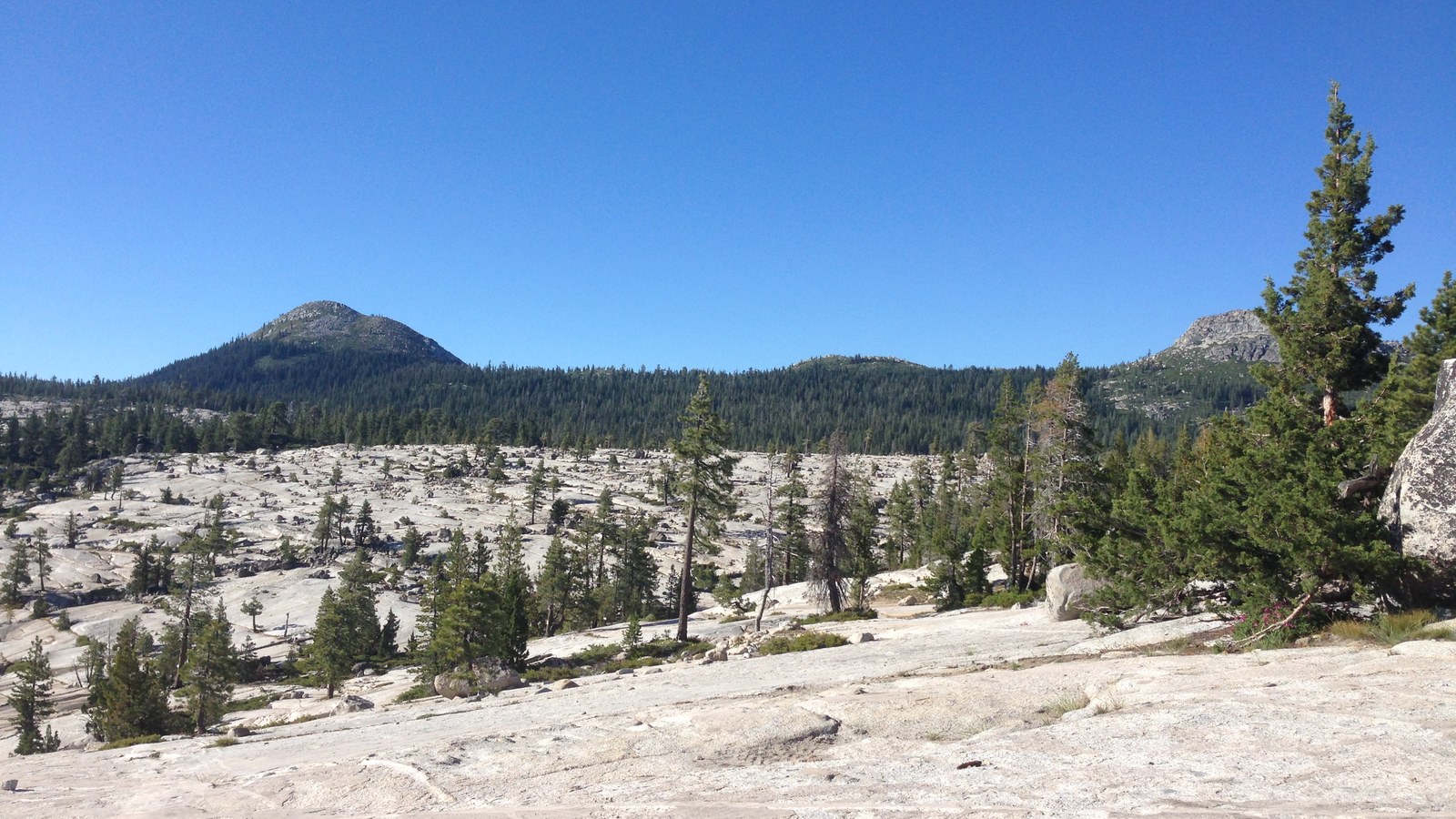 Photo: Wikimedia Commons
The obstacles, in order
Running from Loon Lake toward Tahoe, the trail strings together a greatest-hits list of obstacles that wheelers talk about by name like old friends.
After Ellis Creek the trail mellows briefly, then hits Walker Hill, a rocky climb that finishes with a notch you can straddle or side-hill. It is named for Chuck Walker, a longtime Jeepers Jamboree guide. A short way past it is the Soup Bowl, an optional climb up a series of ledges off to the side of the main trail. High clearance and a long wheelbase help a lot here, and plenty of people drive right past it rather than tangle with it.
Then comes the headliner: the Little Sluice, also called the Sluice Box or just “The Box.” Sitting near Spider Lake, this is the obstacle the Rubicon is most famous for, a tight channel of big granite that has humbled a lot of expensive rigs. There are two bypasses if the main line is past you or your truck: the long bypass to the left, and a line up Toyota Rock to the right that leads onto the surrounding slabs. The county actually reduced the size of the biggest rocks here in the fall of 2012 to break up the spectator-party atmosphere that used to clog the spot, so it is a touch easier than the legends make it sound, but it is still no joke.
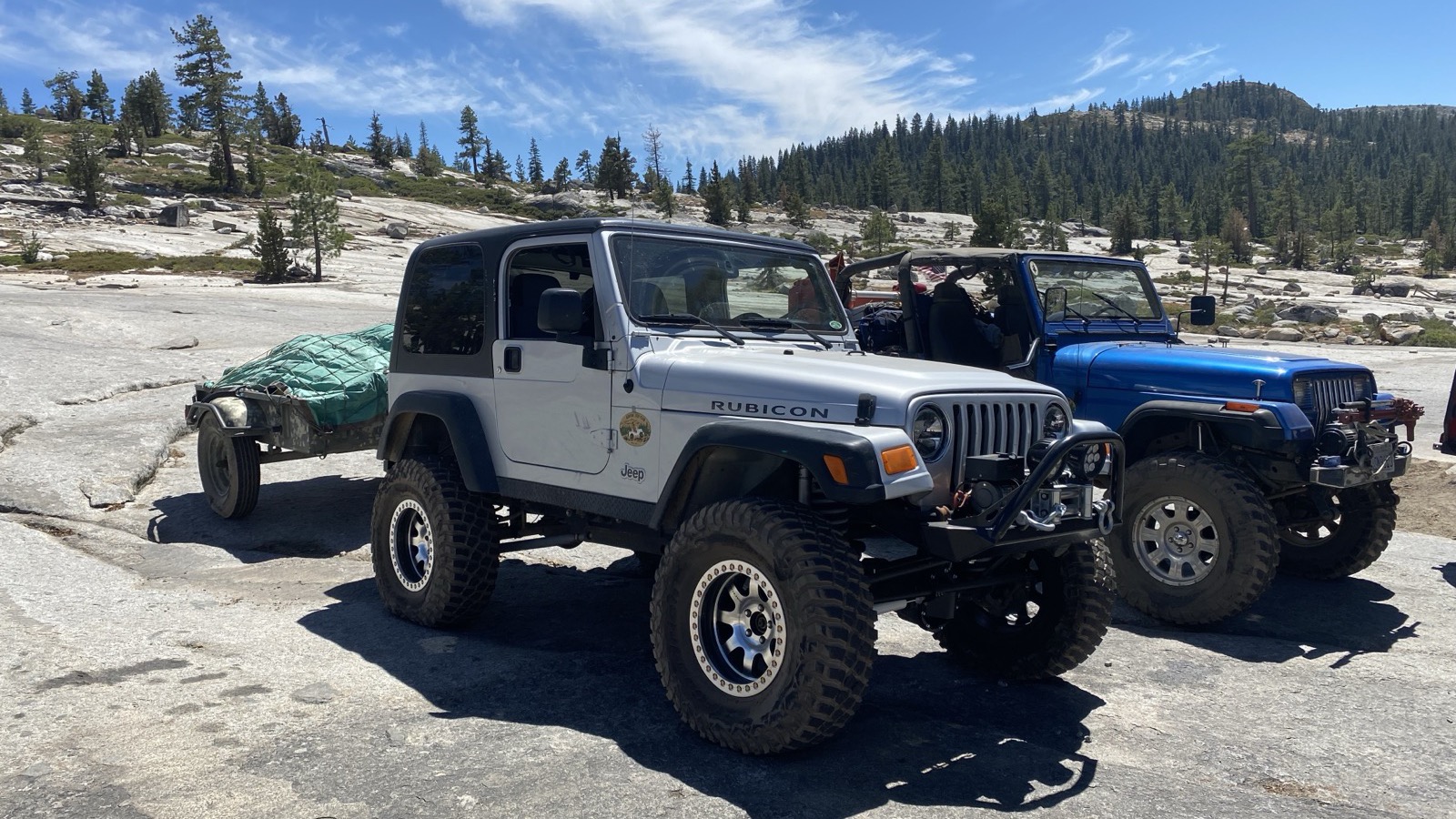 Photo: Jimzubrowski / Wikimedia Commons (CC BY-SA 4.0)
Past the Sluice you reach Thousand Dollar Hill (you will also hear it called Million Dollar Hill), though the main obstacle has been closed since 2012 and everyone now runs the old bypass. Next is Arnold’s Rock, named for the Arnold brothers who guided this stretch at the early Jamborees. A bit further the trail splits: you can stay low on the granite slabs, sometimes called the Indian Trail, which is off-camber but faster and easier, or take the upper original line through the Old Sluice. Both drop you toward Buck Island Lake.
From there the trail tips downhill into the Big Sluice, a rocky, off-camber descent with a switchback and a real drop-off that demands respect, especially since you are heading down it. The Big Sluice spits you out at the Rubicon River Bridge and into Rubicon Springs.
Buck Island and Rubicon Springs
These two spots are why the multi-day trip is the right call. Buck Island Lake is a gorgeous alpine reservoir roughly midway through, and Rubicon Springs is the legendary backcountry camp down in the river valley. Heads up: Rubicon Springs is private property with a caretaker family living on-site, and it has to be respected as such. It is big enough that the major organized events base their whole operation there, and there is even a helipad for emergencies and for flying in supplies during the big runs.
Speaking of those events, the Rubicon has a deep tradition of them. The Jeepers Jamboree caps at 500 vehicles, the Jeep Jamboree runs around 200, and the Toyota crowd has the Rubithon while the Marlin Crawler Round-Up draws another big group. If you want solitude, check the calendar and avoid those weekends. If you want to soak in the culture of the place, time your trip for one.
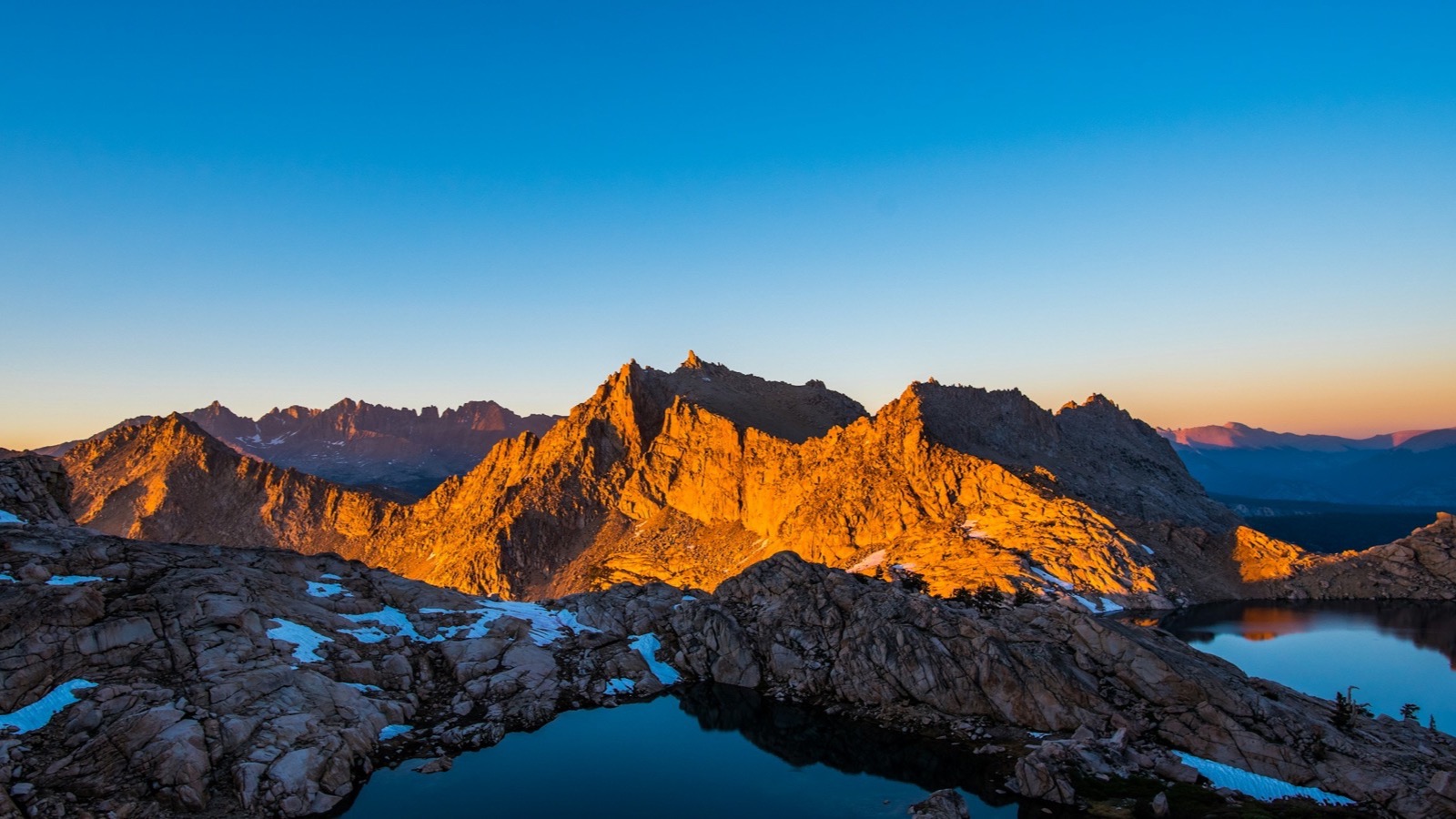 Photo: Siddharth Dedhia / Unsplash
Cadillac Hill, the grand finale
After Rubicon Springs comes the last big test, Cadillac Hill. It is a series of switchbacks climbing up to Observation Point, and it starts with a rutted, root-laced section that gets your attention right away. Around a hairpin the trail goes very off-camber and throws a field of boulders at you to crawl over or pick around, then finishes with a steep stair-step. The payoff is Observation Point, a spot to catch your breath and look back down at everything you just drove. After that there are a few minor rocky bits like the Potato Patch, but nothing serious. From there it is the long dirt road down to Tahoe.
The rig you actually need
Let me be straight, because people get hurt and rigs get destroyed out here by showing up underprepared. The Rubicon Trail Foundation will tell you a brand new stock Wrangler can technically make it if you have the driving skill and you take every bypass. They will also tell you, in the same breath, that you should expect sheet metal damage at a minimum. That is the honest baseline. Body damage on the Rubicon is normal, not a sign you did something wrong.
What the Foundation actually recommends to keep your truck in one piece: at least 33-inch tires, around a 3-inch lift, rocker guards or other body protection, and a locking or limited-slip differential. Realistically, the rigs you see comfortably running the harder lines are wearing 35s or bigger, a locker at each end, full skid plating and rock sliders, and a winch. A winch is not a luxury here. When you get cross-axled on granite with nothing to stack rocks against, a winch and a buddy are how you get unstuck.
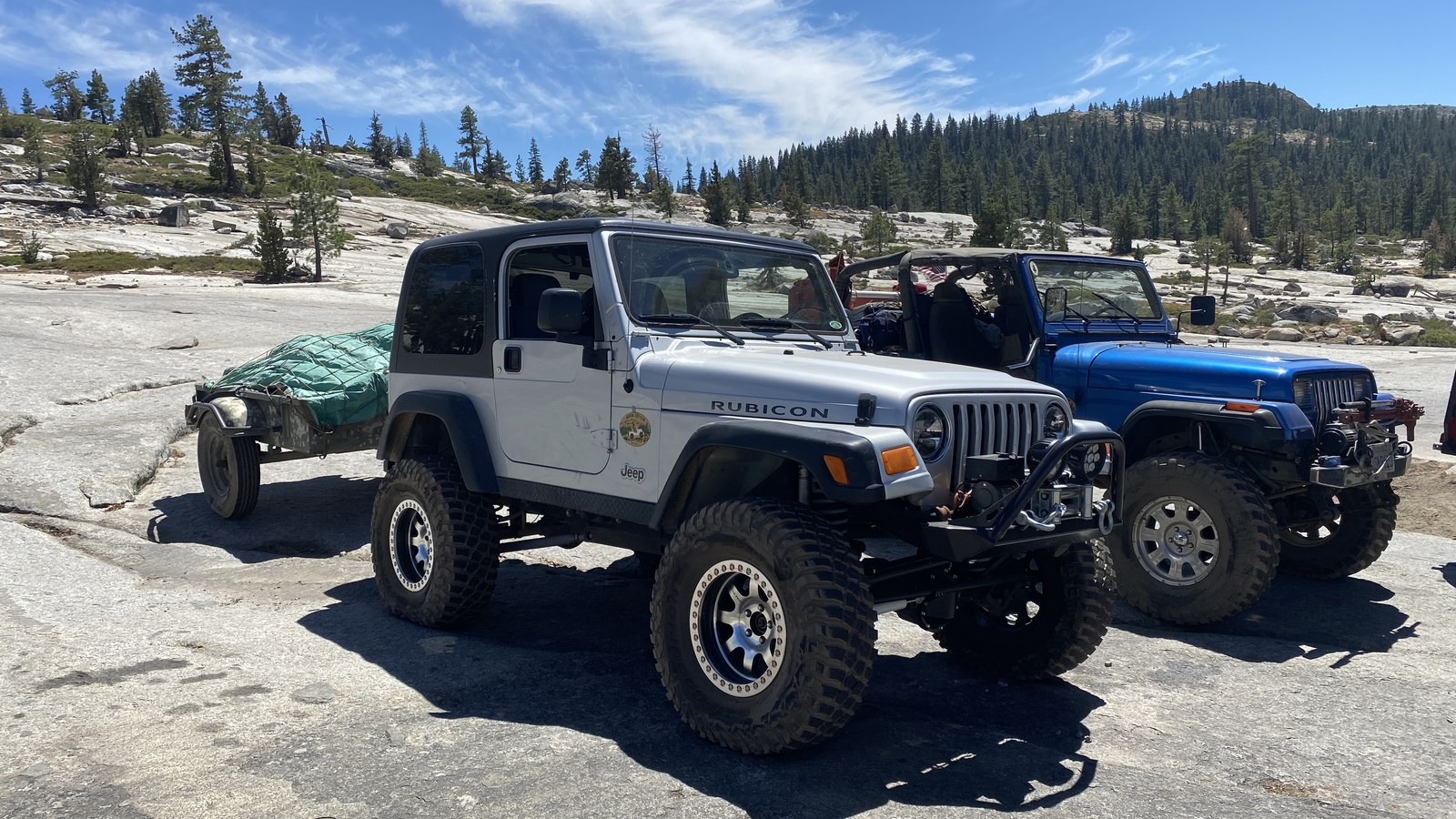 Photo: Wikimedia Commons (public domain)
Bring the recovery basics and know how to use them: a winch with a tree saver and a snatch block, recovery boards, a hi-lift or a good bottle jack, a full-size spare, a tire repair kit, and an air compressor for the run home. Air down for the granite. Lower pressure wraps the tire around the rock and gives you grip you simply do not have aired up, and it is easier on the trail surface too. And the cardinal rule out here: never run the Rubicon alone. Travel with a capable group and at least one rig set up for serious recovery. Cell coverage is essentially nonexistent across the trail portion, so your group is your safety net.
Permits, the WAG BAG rule, and staging
Good news first: there is no permit and no fee just to drive the Rubicon. Any street-legal vehicle is welcome. If your rig is not street legal, California law means you need a green sticker and a working spark arrestor to run it.
Now the rule nobody loves talking about but everybody has to follow. El Dorado County enforces a strict Pack-it-In, Pack-it-Out policy for human waste, and the county-recommended tool is the WAG BAG. There are vault toilets at the trailheads and at Ellis Creek, but once you are in the backcountry around Spider Lake, Buck Island, and the camps, there are no facilities at all. You carry your waste out. They call the toilet paper people leave behind “white flowers,” and stamping that out is a big part of keeping the trail open. Pack a few WAG BAGs, use them, and dispose of them in a trash bin off the trail, never in a toilet.
For staging, the Loon Lake area has a staging zone and parking at the end of the pavement where most groups air down and air out their plans before dropping in. Top off your fuel and stage everything in town. There is nothing to buy once you leave.
Best season and the snow window
The Rubicon is a summer trail, full stop. It is generally passable from late June through September once the snow has melted off the high granite. The sweet spot most veterans point to is late July into August, when the obstacles are dry, the nights are cool enough to sleep well, and the worst of the snowmelt mud is gone.
That snowmelt timing matters more than the calendar. Friends of the Rubicon usually start their maintenance work in late spring, fixing water bars and washouts before the season really opens. The Foundation’s own motto is “make dust not mud,” and they ask people to hold off until the trail dries, because running it wet tears up the surface and dumps sediment into the watershed. If you show up too early and the high sections are still running with snowmelt, the right move is to wait. Always check current trail and fire conditions before you go, since fire restrictions can shut down campfires or more.
The preservation fight, and why it matters to you
Here is the part casual visitors miss. The Rubicon is open today because the off-road community fought to keep it that way. Back in 2001 the Lahontan Water Board floated closing the east end of the trail over erosion and water-quality concerns. In response a grassroots group called Friends of the Rubicon formed, and volunteers built more than thirty erosion-control devices on the trail to protect the watershed. The Water Board backed off, and FOTR has run work projects on the trail every year since.
These days the trail is overseen by the El Dorado County Rubicon Oversight Committee, which manages the corridor from the Loon Lake and Airport Flat entrances out to the Placer County line, and the nonprofit Rubicon Trail Foundation, whose whole mission is responsible, year-round, motorized access. That is the deal we all live under out here. The trail stays open as long as the people using it treat it right. So stay on the designated route, turn around instead of going around an obstacle you cannot clear, pack out every scrap including your waste, and leave the granite better than you found it.
Drive it once and you understand why people guard it so fiercely. The Rubicon is not the prettiest trail in the country or the longest or even the single hardest, but no other trail carries the weight of history, challenge, and community that this one does. Earn your turn out there, take your time, and let it take as many days as it takes.
Hero photo: Jonathan Bottoms / Unsplash