
Most people who drive into the Needles District of Canyonlands never see the part that makes off-roaders lose sleep over it. They pull into the visitor center, snap a few photos of the spires, and turn around. The good stuff starts where the pavement quits, at a wall of red slickrock that the National Park Service quietly calls one of the most technical four-wheel-drive roads in the entire state of Utah.
That is Elephant Hill. It is a permit-only backcountry route inside a national park, which means it is one of the very few places in America where you get world-class rock work AND a ranger checking your paperwork at the same time. It is not a rock-crawling park where you can send it and worry about consequences later. Break down back here and a tow bill routinely runs north of $1,500. But if you come prepared, this is arguably the best 4x4 trail in any national park in the country, and it delivers a landscape you cannot get anywhere else.
Here is how to run it right.
What Elephant Hill Actually Is
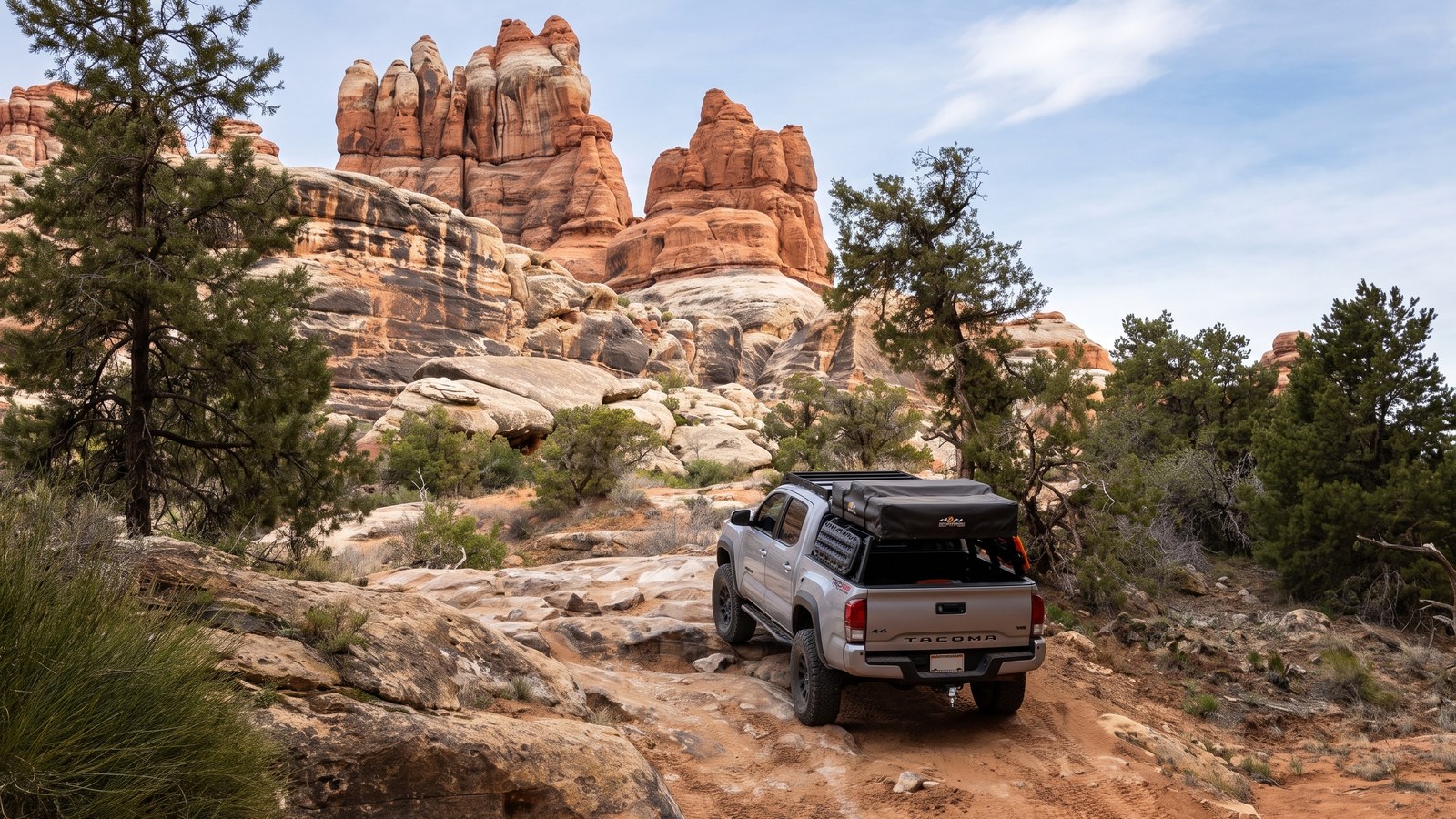
Elephant Hill is the gateway to roughly 50 miles of interconnected backcountry roads in the Needles District, and it sits about seven miles west of the Needles Visitor Center off Utah Highway 211. The name specifically refers to the brutal opening climb, a stair-stepped slickrock grade that people have been cussing at for decades. The Park Service has actually cemented some of the worst ledges over the years so drivers stop stacking loose rocks to get over them, and it is still hard.
A quick note on mileage, because mapping apps confuse people here: the named Elephant Hill segment itself, from the trailhead over the hill to the one-way loop junction, is only about 2 miles, and that is the number apps like onX show for “Elephant Hill.” Our mileage covers the full standard route: over the hill, around the one-way loop and Devil’s Lane, out to the Confluence Overlook spur, and back. That full loop network runs close to 22 miles if you drive the whole thing, and most groups take around six hours to do it with stops. The core Elephant Hill loop itself is a one-way system, so once you commit over the hill you are following the arrows. Along the way you connect to legendary side objectives: the Confluence Overlook where the Green and Colorado Rivers meet, the Joint Trail hiking access, Chesler Park, and Bobby’s Hole to the south, which drops you out to BLM land.
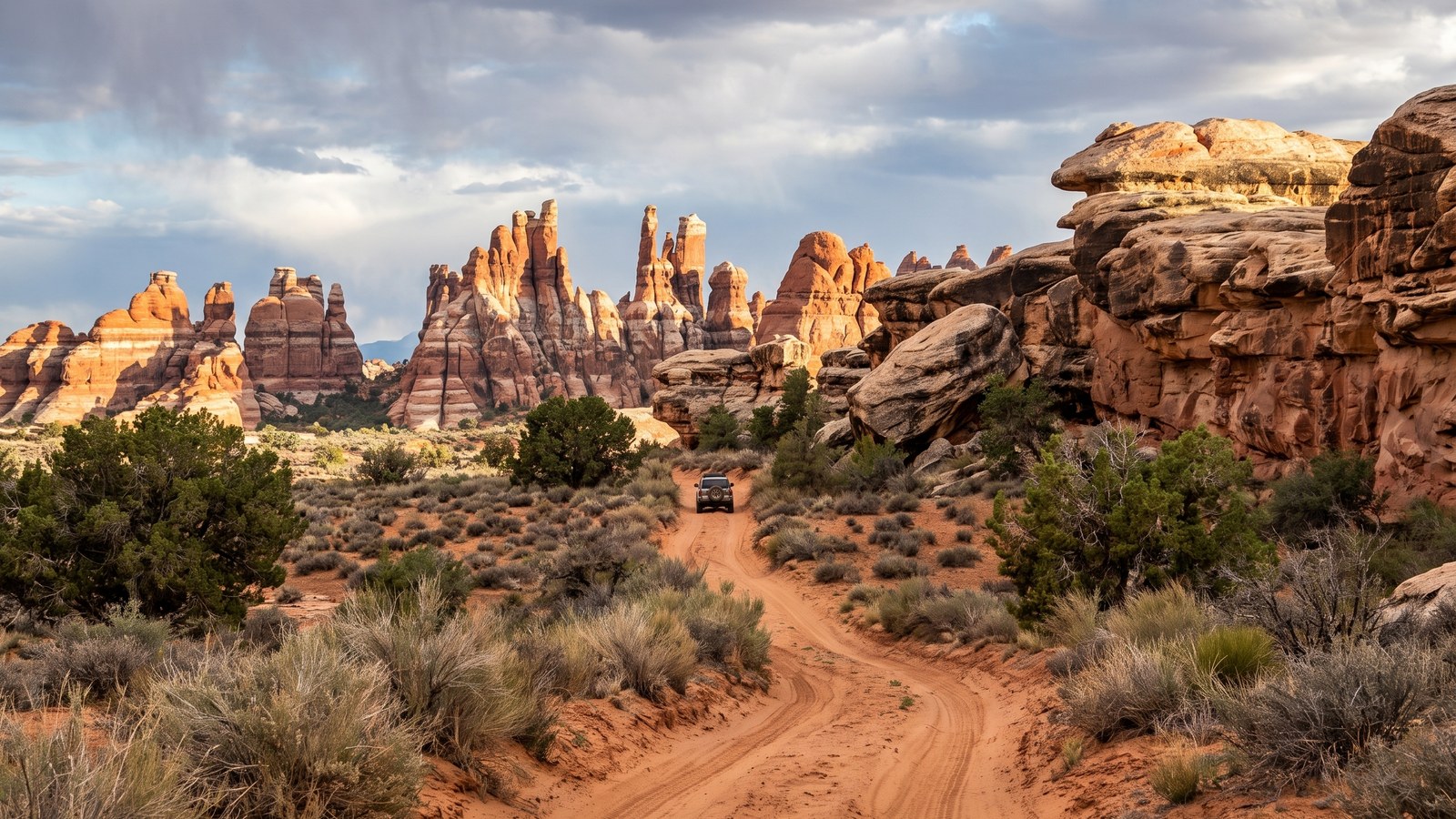
The character here is pure Cedar Mesa sandstone. Banded red-and-white spires stand in clusters, which is exactly why they named it the Needles. You drive across open slickrock, drop into sandy washes between rock fins called grabens, and thread ledges with real exposure. It is technical, it is remote, and it is gorgeous in a way that photos never quite capture.
Getting There and the Permit You Cannot Skip
Access is straightforward: from Moab, take US-191 south, then Utah Highway 211 west into the Needles District. Highway 211 is paved and scenic all the way to the visitor center. From there, a graded gravel road runs the last few miles to the Elephant Hill trailhead and staging area, and even a careful passenger car can reach the parking lot. The trail itself begins right at that lot.
Now the part you cannot skip. You need a day-use permit to drive Elephant Hill Road, and it is separate from your park entrance fee. This is a hard rule, not a suggestion. The Park Service issues only 24 vehicle day-use permits per day for Elephant Hill, and group size is capped at three vehicles, with groups required to be separated by 30 minutes of travel time. During spring and fall, those permits go fast.
You can reserve a day-use permit online at Recreation.gov starting at 8 a.m. mountain time the day before your trip. Online reservations carry a $6 Recreation.gov fee. Any permits not reserved online are available in person at the visitor center the day of your trip at no additional permit charge, issued up to one hour before closing. On top of that, every vehicle pays the standard Canyonlands entrance fee at the gate.
If you plan to camp back there overnight, that is a different permit entirely. Overnight backcountry trips require an overnight permit tied to a specific designated campsite, and demand in peak season frequently exceeds availability. Reserve early.
The Obstacles, In Order
The reputation is earned in the first mile. The majority of the hard stuff is right at the start, on Elephant Hill itself.
The climb up Elephant Hill. Straight out of the lot the road wastes no time getting steep. You are on stair-stepped slickrock ledges with loose rock in places, and it demands high clearance and low range immediately. Momentum management matters here, but so does restraint, because there is nowhere to run out if you get it wrong.
The switchbacks and the back-up section. This is the piece Elephant Hill is famous for. Near the top the road hits switchbacks so tight that a normal-length vehicle physically cannot make the turn in one motion. You drive forward as far as you can, then reverse UP a steep slickrock section to complete the turn. Backing uphill on rock with exposure on one side is genuinely nerve-racking the first time, and it is why the Park Service enforces a 21-foot maximum vehicle length, racks and trailers included. Long wheelbases simply do not fit.
Descending the far side. What goes up comes down. The backside descent off the hill is its own event, with steep ledges where good brake control and line choice keep you off the skid plates.
The grabens and the Silver Stairs. Once past the hill, the road runs through the grabens, long sunken valleys between rock fins, with ledge obstacles scattered throughout and a section of slickrock at the Silver Stairs. There is also a tight one-way loop with an interesting squeeze where the rock closes in on both sides.
None of it is Extreme in the hardcore-park sense. FunTreks and the broader community rate the trail Difficult. But the combination of exposure, remoteness, and the fact that you cannot simply turn around means it punches above its numeric rating in consequences.
The Rig You Actually Need
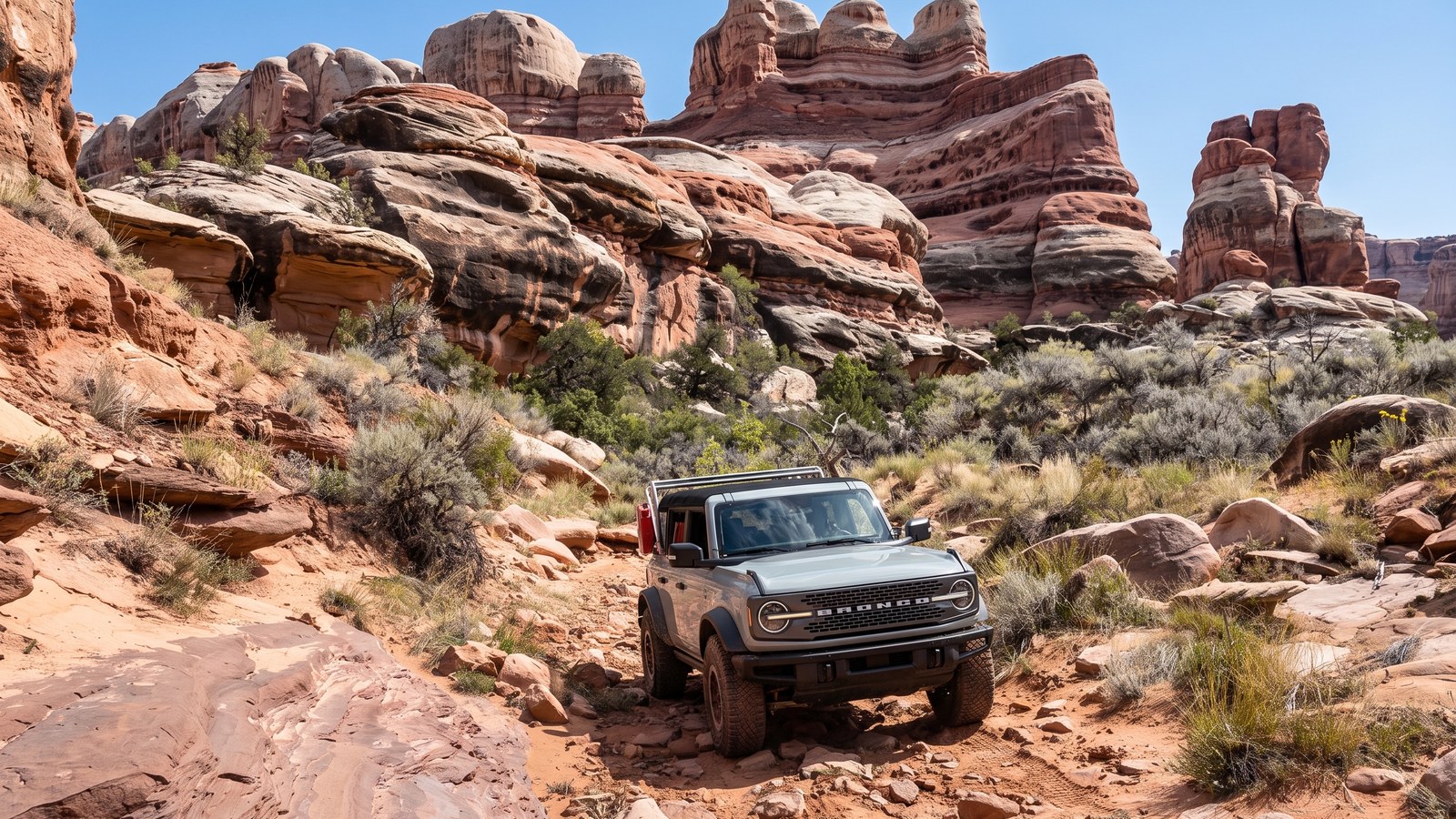
The Park Service is blunt about this, and so are we: you need a high-clearance, low-range four-wheel-drive vehicle. All-wheel drive does not count. ATVs, UTVs, and OHVs are flat-out prohibited inside the park, even if they are street-legal. Motorbikes must be equipped and licensed for interstate travel. Your vehicle must be registered and driven by a licensed driver, and no pets are allowed, not even riding along inside the truck.
Honest minimums for a comfortable, low-drama run:
- Real 4WD with low range. Non-negotiable. You will use low range on the climb and the descent.
- Ground clearance and skid plates. Stock skids get worked on the ledges. Aftermarket armor buys peace of mind.
- At least one locker. A rear locker makes the stair-steps far easier. Front and rear is better.
- A-T or M-T tires, aired down. Slickrock rewards a soft, compliant tire footprint. Air down at the staging area.
- Recovery gear and the skill to use it. There is no cell service and no shade. You are self-sufficient out here. Carry traction boards, a strap, a proper recovery point, and water for more than you think you need.
- A spotter. For the back-up switchbacks and the tight squeezes, a second set of eyes is worth more than any mod.
Stock, unmodified vehicles are not recommended, and a long-wheelbase truck over 21 feet is not just discouraged, it is illegal on this road.
Rules, Pack-Out, and Leave No Trace
Canyonlands is a national park, and the backcountry ethic here is strict for good reason. All vehicles must stay on designated roads, period. Driving off-route through this desert crust does damage that lasts for decades.
Pack it in, pack it out, and that includes human waste. Do not rely on finding a vault toilet out on the road system, and do not bury waste or trash in the backcountry. Bring a wag-bag or a reusable toilet system and carry everything out. It is not glamorous, but this landscape stays pristine only because people actually do it.
Check current road conditions before you go. Flooding and poor weather can make sections impassable, and slickrock that is easy when dry gets treacherous when wet.
Best Season and Weather
The window is roughly March through November, with spring and fall being the sweet spot. Summer in the Needles is genuinely dangerous heat, regularly topping 100 degrees with zero shade on the trail, and it is not the time to be stuck back here. Spring (March through May) and fall (September through November) give you milder temperatures and the best light on the red rock.
Watch the sky in any season. This is flash-flood country, and the washes and grabens can fill fast during a storm. If rain is in the forecast, reconsider, because wet slickrock and running washes turn a Difficult trail into a genuine hazard.
Why It Is Worth It
Elephant Hill asks a lot. The permit, the prep, the back-up switchbacks, the pack-out rules, the remoteness. It filters out the casual crowd, and that is exactly what makes it special. When you crest the hill and drop into the grabens with the Needles standing over you, and you realize you are wheeling inside one of the most protected landscapes in the country, legally and responsibly, it lands differently than any rock park ever will.
Do your homework, pull the right permit, bring the right rig, and treat the place like it deserves. Then go see the part of Canyonlands almost nobody sees. It is one of the great ones.