
Hell’s Revenge is the trail people picture when they picture Moab. The two dark tire tracks cresting a sandstone fin and dropping out of sight over the far side, the snow on the La Sals floating behind the red rock, the spine you climb at the very start with a wall of sky in the windshield. This is the world’s most famous slickrock trail, and it has earned the name. It is also one of the most misunderstood, because two very different trails share it. There is the main line, which thousands of capable drivers run every season in fairly stock rigs. And there are the optional obstacles bolted onto the side of it, places like Hell’s Gate and Tip-Over Challenge, that will end your day and bend your truck if you walk up to them with too much ego and not enough spotter.
Here is the honest version of what you are getting into, and how to tell the two trails apart before you commit.
What Hell’s Revenge actually is
Hell’s Revenge sits in the Sand Flats Recreation Area, a 9,000 acre playground of bare Navajo sandstone just east of downtown Moab. The trail is a loop, roughly 6.5 miles long, and the BLM says to plan two to three hours to run it. That mileage and that time are deceptive. This is not a long trail, but it is a slow one, because almost every foot of it is either climbing a dome, balancing along a fin, or tipping down the far side of something steep enough to get your attention.
The rock itself is the whole story. Locals call it slickrock, which is a terrible name, because dry Navajo sandstone grips a rubber tire like coarse sandpaper. The name is a holdover from the wagon days, when steel-rimmed wheels and iron horseshoes found no purchase on the smooth stone. Modern tires love it. That traction is what lets a truck climb pitches that look impossible from below, and it is what makes the steep rollovers feel sane instead of suicidal. The trail is a roller coaster, and the grip is the safety bar.
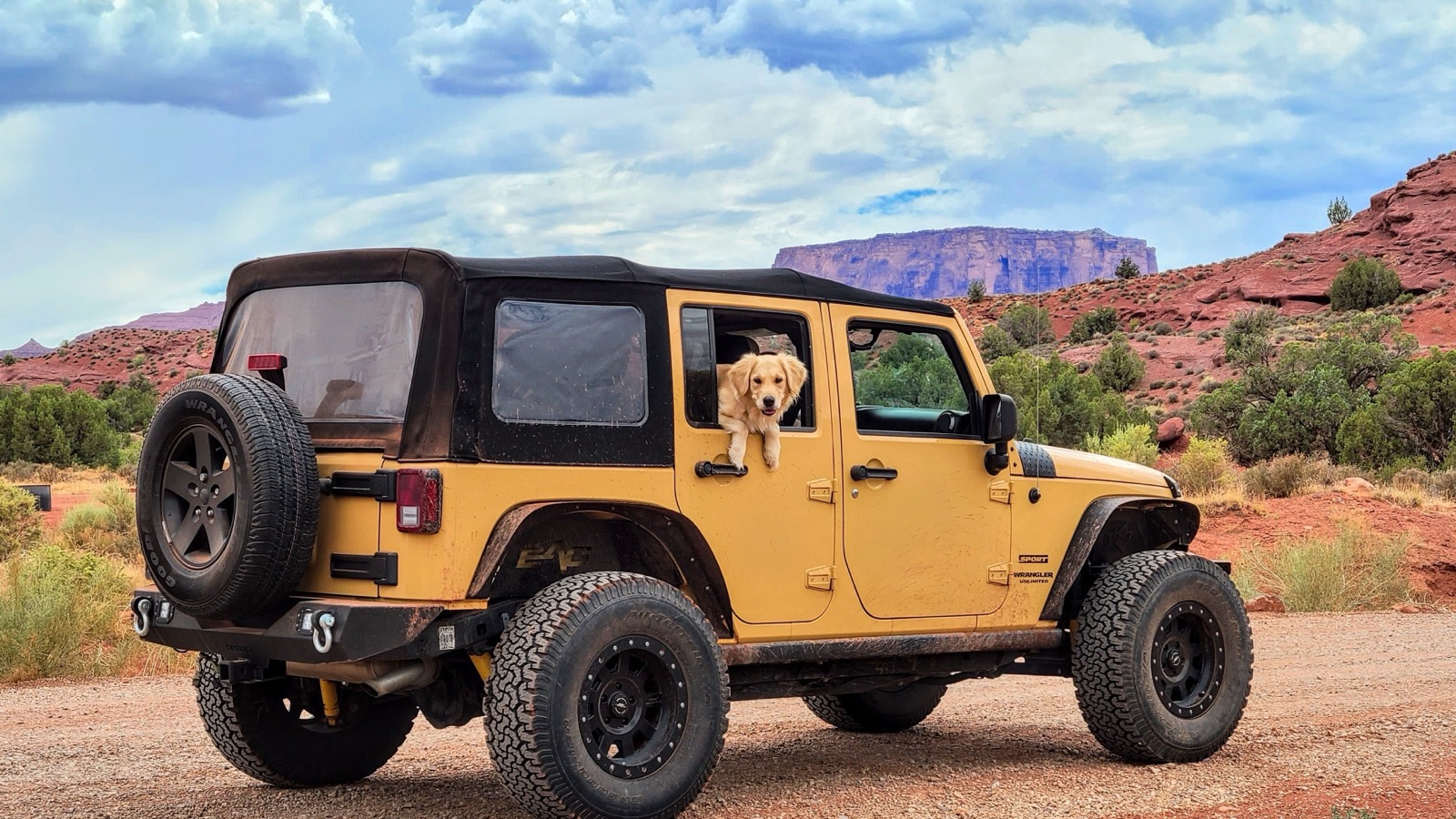 Photo: Dakota Edwards / Pexels
Hell’s Revenge shows up on most wheelers’ short list of bucket-list trails, and it is a Jeep Badge of Honor trail, so expect company. It is one of the most popular routes in Moab for a reason. The scenery is genuinely world class, with overlooks down to the Colorado River and across to Arches, and the driving is theatrical in a way that few trails anywhere can match. You will be grinning, and so will everyone watching you from the next fin over.
Getting there and the famous entrance
The trailhead is easy. From US Highway 191 in Moab, turn east on 300 South, go to 400 East, turn right and follow it to Mill Creek Drive, then take Mill Creek Drive east onto Sand Flats Road. Sand Flats Road is paved all the way to the Hell’s Revenge trailhead parking lot, which sits just past the Sand Flats entrance station, a little over a mile from town. The lot is on bare sandstone and big enough for trailers. You are airing down at the trailhead barely fifteen minutes after leaving Main Street.
The trail makes its reputation in the first hundred yards. The entrance is a slickrock spine, a narrow hogback ridge you climb with steep drops falling away on both sides. It looks far worse than it drives. The grip is incredible and the line is obvious, but it is a genuine commitment for a first-timer, and it is exactly the moment a nervous passenger decides whether they trust you. Take it slow, keep your wheels on the marked route, and let the traction do the work. Once you are over the spine, you are on the trail proper.
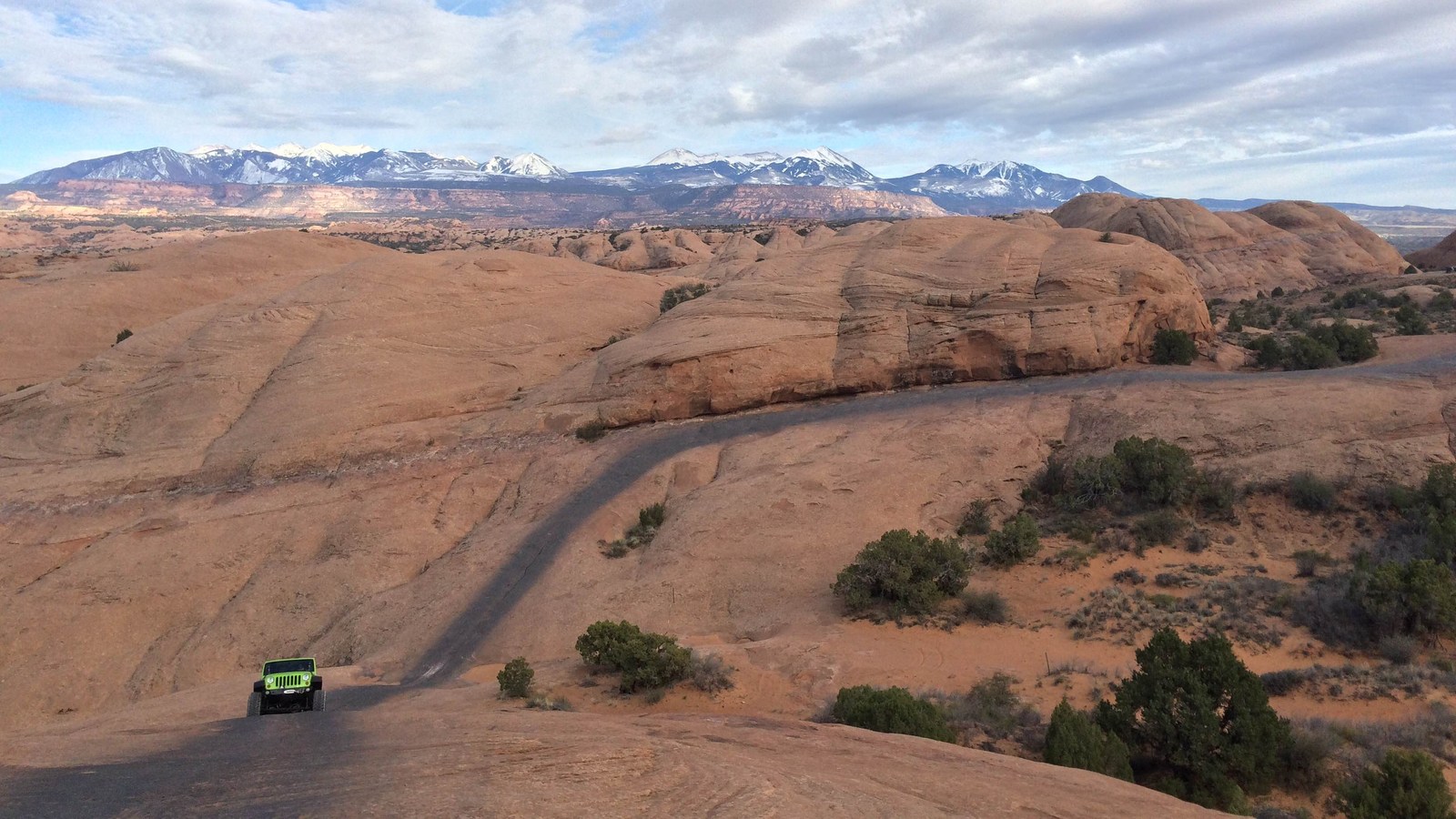 Photo: BLMUtah / Pam Jarnecke / Wikimedia Commons (public domain)
One thing to burn into your brain before you start: Hell’s Revenge is intertwined with the Slickrock Bike Trail. The two routes cross at several points, marked with painted white dashes on the rock, and those crossings are open to motorcycles and mountain bikes. Bikers always have the right of way. Slow down, look both ways, and yield at every crossing. A blind crest on slickrock is no place to surprise a cyclist.
The main line versus the optional obstacles
This is the single most important thing to understand about Hell’s Revenge, so read it twice. There are two trails here.
The main line is rated Difficult. It is steep, it is committing, and it has several large rock ledges that cannot be bypassed, plus long stretches of narrow, off-camber fin driving. The BLM flatly calls the route extremely difficult and says it is for experienced drivers only, not ATVs. All of that is true and you should respect it. But the main line is also run constantly by fairly ordinary rigs. People take 33-inch-tire Tacomas and stock Rubicons across it every day, scrape a skid plate or two, and come out the other side grinning. The local Red Rock 4-Wheelers put it plainly: the most difficult obstacles on Hell’s Revenge are out of the stock-vehicle class, but those obstacles can be bypassed. The main line is the trail almost everyone actually drives.
Then there are the optional obstacles, and these are a different sport entirely. Hell’s Gate, Mickey’s Hot Tub, the Escalator, and Tip-Over Challenge are extreme, and they are genuinely dangerous. FunTreks recommends front and rear lockers just to attempt them, and an experienced spotter is not optional. These are the spots you have seen in the videos where a built Jeep claws nearly vertical up a notch in the rock with a body alongside calling every tire placement. They are bolted onto the loop as side challenges, each with a way around, so you can walk up, watch the carnage, and decide. There is zero shame in choosing the bypass. Picking a line past your rig or your skill and getting hung up halfway up Hell’s Gate is how trucks get rolled and how a fun day turns into a recovery operation that closes the obstacle for everybody behind you.
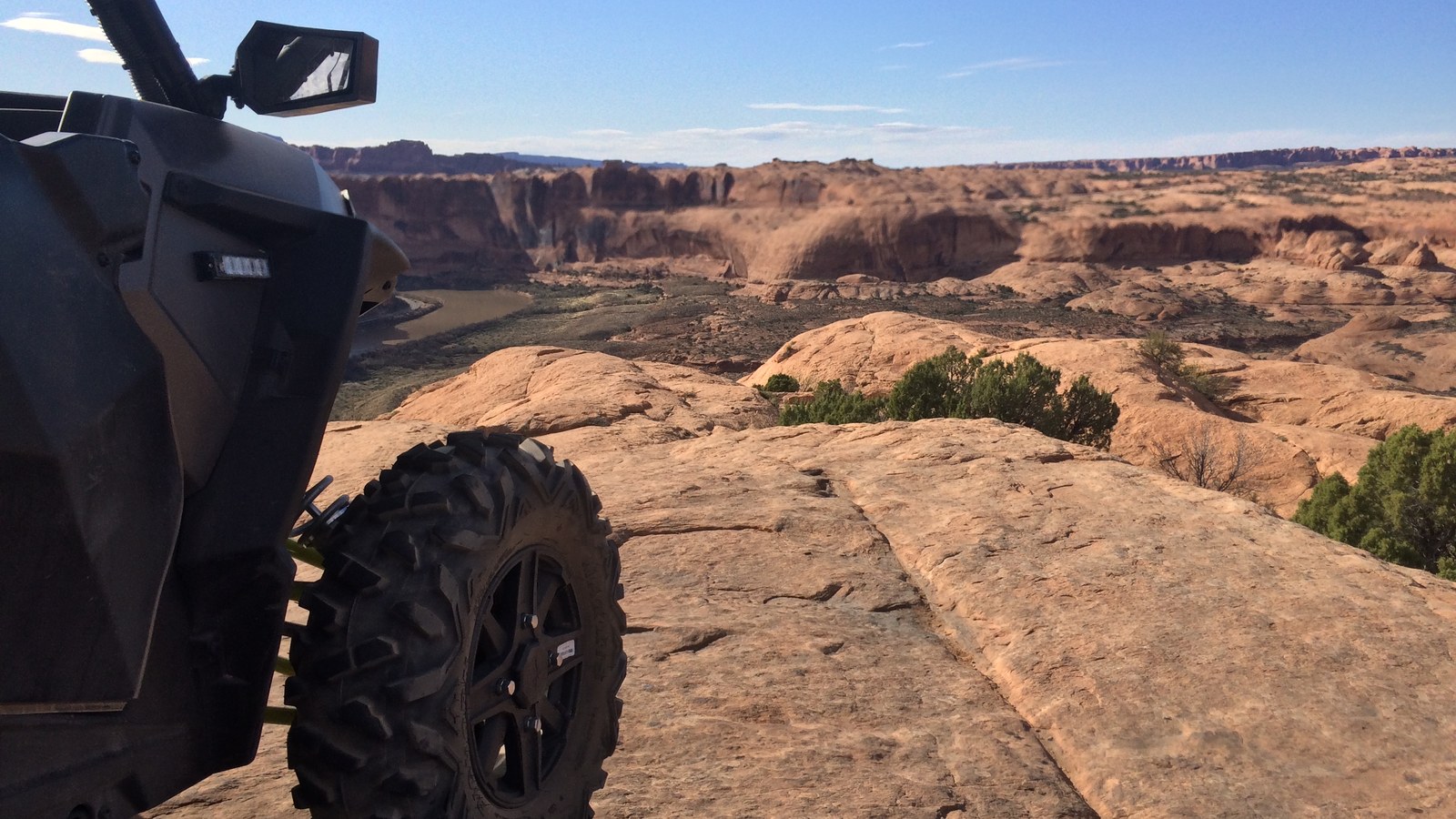 Photo: BLMUtah / Pam Jarnecke / Wikimedia Commons (public domain)
The named obstacles worth knowing, roughly in the order they come up:
The Hot Tubs. There are several of these, big bowls scooped into the slickrock that you drop into and climb back out of. The three most famous you can actually drive are the Car Wash, Mickey’s Hot Tub, and Devil’s Hot Tub. Devil’s is the widest, deepest, and steepest of them. Mickey’s is the crowd favorite, a hole in the rock big enough to swallow an entire vehicle, and yes, it gets hot down in there. These range from doable to no.
Hell’s Gate. The headline act. A steep, narrow notch in the rock that demands real articulation, real traction, and total commitment. This is a lockers-and-a-spotter obstacle, full stop. Watch a few rigs run it before you even think about it.
The Escalator and Tip-Over Challenge. The Escalator is a steep climbing ledge sequence. Tip-Over Challenge is usually the last official obstacle on the loop, a steep, off-camber incline that does exactly what the name promises if you get your line or your weight wrong. Both have bypasses, and both are worth respecting.
Note that the trail has evolved a bit in recent years. A newer signed exit option called the Staircase ties back into the route and gives shorter rigs an alternate way out, and a cut-through near Tip-Over Challenge now lets you exit back toward the start. Pick up the current Sand Flats map or run onX so you know which junctions are which, because the painted symbols and signs on the rock are what keep you on the legal, sane line.
The rig you actually need
Let me be straight, because people get themselves and their trucks in trouble here by under-building and over-committing in equal measure.
For the main line, the real bar is a high-clearance four-wheel-drive with low range. Good tires matter more than anything else out here, because traction is the entire game on slickrock. A stock Wrangler, a 4Runner, a Tacoma, a Bronco, or a capable full-size on decent tires will run the main route if the driver is patient and picks clean lines. onX lists the trail’s steps as not exceeding about 36 inches, and recommends tall tires, 33 inches and up, with a couple of traction aids like lockers or limited-slips for the harder bits. You do not strictly need all of that for the main line, but a rear locker and real clearance take a lot of the stress out of the big ledges. What absolutely does not belong here is an all-wheel-drive crossover on street tires with no low range. This is not that kind of trail.
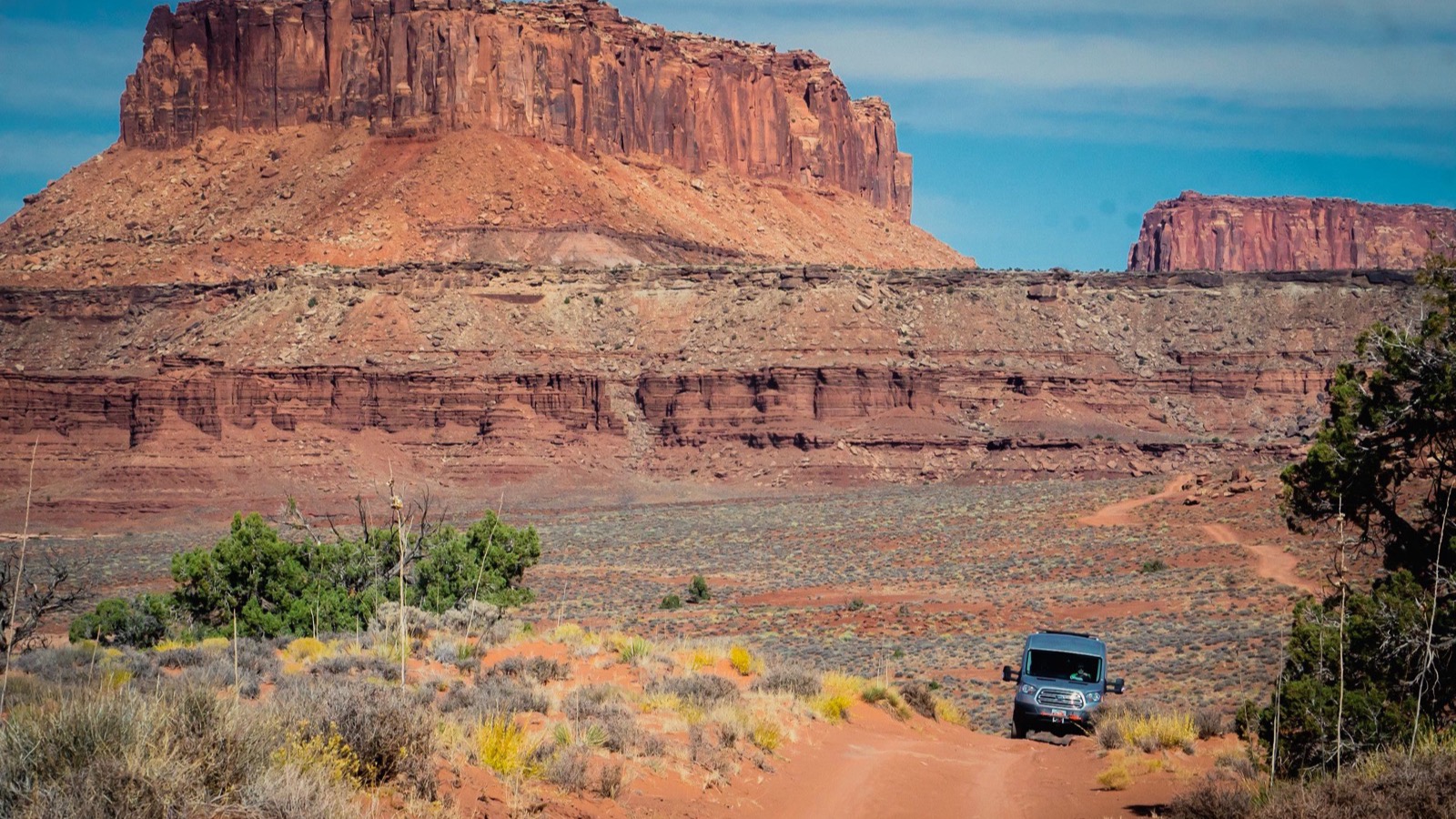 Photo: Brent Olson / Pexels
For the optional extreme obstacles, the bar jumps. Front and rear lockers, serious clearance, good approach and departure angles, skid plates you do not mind using, and a spotter who has done it before. If you are asking whether your rig can do Hell’s Gate, the answer for a stock truck is no, and that is fine, because you can run the entire loop and skip it.
Either way, bring the basics. Air down before you start, because lower pressure puts more rubber on the rock and transforms how the truck climbs. Most folks on street-biased tires settle in the high teens to low 20s psi here, and dedicated rigs on beadlocks go lower. Carry a real air compressor so you can air back up before you hit the highway, because trail pressure on hot pavement builds dangerous heat and chews up tires. Bring recovery gear, a spotter, plenty of water, and a buddy. Cell service up here is limited to nonexistent.
Permits, fees, and the rules that keep it open
Hell’s Revenge lives inside the Sand Flats Recreation Area, which is run through an unusual partnership between Grand County and the BLM. The whole place is self-funded entirely by fees and gets no tax dollars, so paying at the booth is literally what keeps it open and maintained. The numbers, straight from Sand Flats: a one-day day-use pass for a private vehicle is 5 dollars, a 7-day pass is 10 dollars, and an annual pass is 25 dollars. If you are in Moab for more than a day, the 7-day or annual pass pays for itself fast. Because Grand County runs the day-to-day operation, standard federal and state passes are not accepted here, though the federal Access Pass was grandfathered in.
If you are running an out-of-state ATV or UTV, you need a Utah OHV permit. Those cost 30 dollars and are valid for 12 months, and they are sold online only. Utah also requires all OHV operators to complete the state’s online Off-Highway Vehicle education course, a rule that has been in effect since January 1, 2023. Sort that out before you show up, not at the trailhead.
The rules on the rock are simple and they matter. Stay on the designated, marked route at all times. There are no open play areas, all play happens on the marked trail, and parking is roadside only. Driving off-trail here is a Class A misdemeanor, and the BLM means it. The posted speed limit is 15 mph. And about half a mile from the trailhead, the Hell’s Revenge Dinosaur Tracksite preserves more than 50 footprints pressed into the rock around 190 million years ago, including tracks from Dilophosaurus. Those trace fossils are protected by law. Look, do not touch, and do not drive on them.
Camping and where to stay
If you want to be first on the rock in the morning, camp right at Sand Flats. The recreation area has roughly 140 individual campsites spread across several loops, first come first served, plus a handful of reservable group sites through Recreation.gov. Camping is its own fee on top of day use. The sites are basic on purpose: vault toilets, picnic tables, and fire rings, with no water and no hookups anywhere. Come fully self-sufficient and bring far more water than you think you need, because there is none up here and Moab summers are brutal.
In spring and fall, the loops fill Thursday through Saturday, often by early afternoon, and run busy the rest of the week too. Roll in early if you want a spot. Camping at Sand Flats is the move if you want to beat both the heat and the conga line of rental Jeeps that builds on the trail by mid-morning. If the campground is full, Moab has the full spread of hotels, food, and fuel a few minutes down the road.
Best season and the summer heat warning
Spring and fall are the seasons, full stop. March through May and September through October give you firm, grippy rock and air temperatures you actually want to be out in. The trail is technically open year-round, and a clear, dry winter day can be a fine time to run it, just stay off the slickrock when it is wet or snowy, because then it genuinely does live up to its name and the grip vanishes.
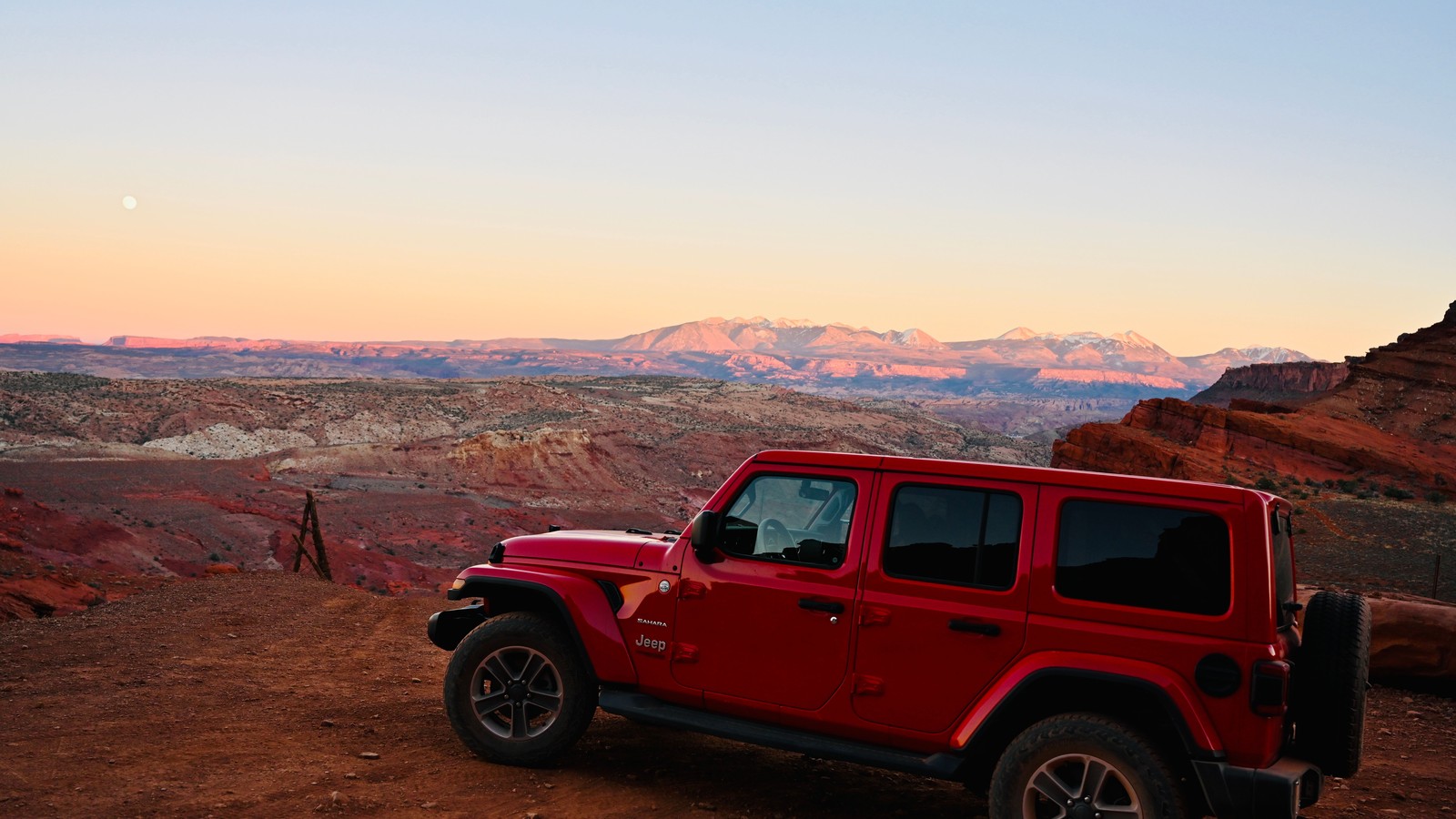 Photo: Francisco Jaramillo / Pexels
Summer is the one to be careful with. Midday temperatures here regularly blow past 100 degrees, the slickrock radiates heat like a skillet, and there is essentially no shade anywhere on the loop. People get into real heat trouble out here every year. If you must run it in summer, go at first light, carry far more water than feels reasonable, and be off the rock before the worst of the afternoon. After about 12 inches of rain the lower spots can also hold water and mud, so check conditions if a storm has just rolled through.
Tread lightly and keep it open
Hell’s Revenge is busy, fragile, and entirely fee-funded, which means it only stays open and only stays this good if the people who run it look after it. The rules here are not bureaucratic noise. They are why this place still exists.
Stay on the marked route, every single time, even when the bare rock makes it tempting to wander. Yield to bikes at the Slickrock Trail crossings and to uphill traffic on the climbs. Pack out everything you bring in, leave the dinosaur tracks untouched, and never cut a new line across the rock or carve a fresh track to dodge a line you do not like. If an obstacle is past your rig, take the bypass with zero ego. The fastest way to get a trail like this closed or restricted is a rollover that ties up search and rescue or a pile of trucks tearing fresh scars into the sandstone.
Drive it with respect and Hell’s Revenge gives you the best day of wheeling in the country, the snow on the La Sals, the river far below, and a spine entrance you will be bragging about for years. Treat it carelessly and the rock does not care how built your rig is. Pick the first one, take your time, and let Moab show you why it is the center of the off-road universe.
Hero photo: Carter Pape / Wikimedia Commons (CC BY-SA 4.0)